
Oct 10, 2026
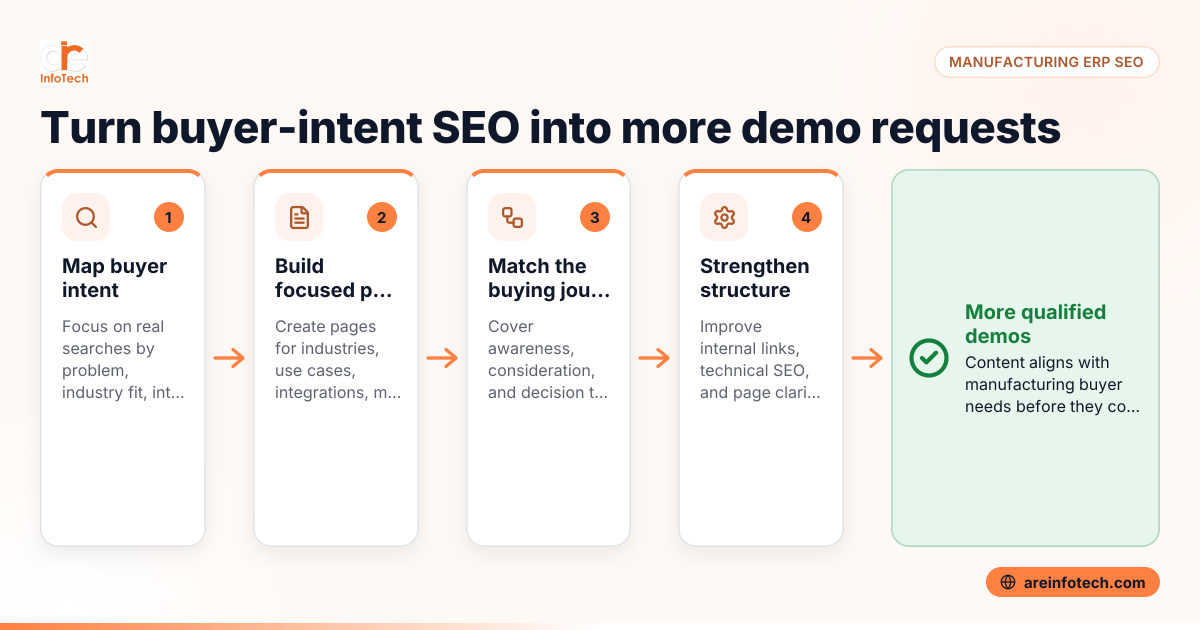
SEO for ERP software companies in United States means building organic visibility for the searches manufacturing buyers use before they book a demo. Done well, it helps your company show up for high-intent topics like production planning, inventory control, job costing, shop floor reporting, and ERP migration, so more qualified buyers from places like Chicago, Houston, and Detroit request demos.
ERP software is rarely an impulse purchase. A manufacturing buyer usually spends weeks or months researching options before talking to sales. They compare features, deployment models, implementation risk, integration options, reporting depth, and total business fit.
That makes SEO a strong channel for ERP software companies in United States. You can reach buyers while they are still defining requirements. You can also influence the shortlist before a paid ad click or outbound email ever happens.
For manufacturing ERP vendors, this matters even more because the sales cycle is complex. A plant manager may care about production scheduling. A controller may focus on inventory valuation and month-end reporting. An operations leader may want better shop floor visibility. An owner may want fewer disconnected systems.
SEO helps you create pages for each of those concerns.
If your site only has product pages and a contact form, you are likely missing buyers who search for specific problems first. They may look for:
These searches often come from buyers with active projects. If your site answers them clearly, you can generate more demo requests from the right accounts.
They search by business problem, industry fit, process need, integration, and migration risk. Your SEO strategy should map pages to each of those search patterns, not just broad “ERP software” terms.
Manufacturing buyers do not all use the same words. A plastics manufacturer may search differently than a machine shop. A finance leader may search for inventory costing. A plant leader may search for production scheduling. Your SEO plan must reflect that buying committee reality.
Broad keywords can look attractive in SEO tools. But many do not convert well. A term like “ERP software” may be too broad. The searcher could be a student, a consultant, or a buyer outside your ideal market.
A better strategy is to build around commercial intent and operational relevance. Look for phrases tied to real evaluation behavior, such as:
These terms often have lower volume. But they usually carry stronger buying intent.
Your content should mirror how buyers define pain inside the plant and back office. Useful topic clusters include:
Create pages around scheduling, MRP, capacity planning, BOM management, routing, and work orders.
Cover inventory accuracy, lot tracking, barcode scanning, replenishment, warehouse visibility, and cycle counting.
Explain job costing, standard costing, WIP tracking, margin reporting, purchasing controls, and connections with QuickBooks or Stripe where relevant to order-to-cash workflows.
Build pages for sectors you serve, such as plastics, metal fabrication, industrial equipment, electronics, food manufacturing, or contract manufacturing. If you serve plastics manufacturers, this related guide on SEO for Plastics Manufacturers in United States: How to Get More RFQs for Injection Molding, Extrusion, and Custom Parts shows how industrial search intent becomes lead intent.
Address common concerns around replacing legacy ERP, moving off spreadsheets, consolidating disconnected systems, and preparing data for implementation.
Use clear pages for industries, use cases, integrations, migrations, and proof-building content. Each page should answer one buyer need and make the next step obvious.
That short answer matters because many ERP websites are too product-centered. They describe modules, but not the buyer’s real problem. A manufacturing prospect wants to know whether your software fits their operation, not just whether you offer inventory, purchasing, and reporting.
A strong SEO structure usually includes these page types:
Traffic alone does not help pipeline. Each page should lead naturally to a demo request or consultation. Add:
For ERP companies, weak CTAs are common. “Learn more” is often too soft. If the page serves commercial intent, ask for the demo.
Content that reduces buying risk drives demos. Buyers need confidence that your ERP can fit their process, data, team, and implementation reality.
This is where many software companies miss the mark. They publish top-of-funnel articles with broad educational intent, but they do not create enough middle- and bottom-funnel content. A manufacturing buyer who is near decision wants specifics.
Comparison content works when it is balanced and useful. Buyers often search your brand against another ERP, or ERP against spreadsheets, or cloud ERP against legacy on-premise systems. Focus on fit, tradeoffs, and evaluation factors.
A buyer wants to know whether your ERP fits make-to-order, engineer-to-order, batch manufacturing, or repetitive production. Generic software copy will not answer that.
Manufacturers worry about downtime, data cleanup, user adoption, training, and reporting continuity. Practical content around implementation planning can convert well.
Different stakeholders need different answers. Consider content for:
Avoid fake numbers. Instead, explain where value usually comes from, such as reduced manual data entry, better inventory accuracy, faster month-end close, and improved schedule adherence.
SEO content must still sound like a helpful sales engineer or consultant. Use plain language. Avoid stuffing pages with repeated keywords. Explain operational terms clearly.
This is also where ai seo matters. AI-powered search tools often pull short, direct answers from pages that explain complex topics simply. If your page gives a clear answer, then expands with detail, it is more likely to earn visibility in AI-assisted discovery.
Write short direct answers under key questions, then support them with detailed sections, strong structure, and specific manufacturing context.
AI-driven search often rewards clear formatting. It can prefer pages that answer practical questions fast. That does not replace traditional SEO. It changes how your content should be organized and summarized.
Turn common sales and discovery questions into headings. Examples include implementation timelines, migration concerns, ERP fit by manufacturing model, and integration complexity.
Open key sections with a short direct answer. Then expand below. This helps both readers and AI systems interpret your page.
Do not stop at “ERP software.” Discuss MRP, BOMs, routings, scheduling, purchasing, inventory control, quality, warehouse operations, and financial reporting. That builds topical depth.
Use short paragraphs, bullets, tables if needed, and clear heading levels. Dense walls of text are harder for users and machines.
Your content should reflect how manufacturing buying decisions actually happen in United States. Mention implementation risk, ERP selection committees, finance stack overlap, and the need for buyer trust around security and reliability.
A useful SEO plan is not complicated. But it does require prioritization. Start with pages closest to revenue, then expand outward.
Be specific. Ask:
For example, if you close best with $10 million to $100 million manufacturers using QuickBooks plus spreadsheets, that should shape your topic map.
Group terms into stages:
This prevents cannibalization and gives each page a clear role.
Start with pages most likely to influence demos:
Internal links help users and search engines understand your topical depth. Link related pages naturally. For example:
If your team serves niche verticals, reviewing related approaches like SEO for MSPs in United States: How to Get More Qualified IT Support and Co-Managed IT Leads or SEO for Accounting Firms in United States: How to Get More Tax, Bookkeeping, and CFO Service Leads can help you see how intent-based structure works across service categories.
Even strong content can underperform if the site has technical problems. Check:
For software websites with many product and resource pages, crawl hygiene matters.
Manufacturing buyers are careful. Add confidence where appropriate:
Many larger buyers also expect signs of mature security practices. If your sales process often encounters SOC 2 questionnaires, your site should address security readiness at a high level where accurate.
Generic copy does not rank well or convert well. Buyers want to know how your ERP solves specific manufacturing problems.
Broad keywords can bring traffic without pipeline. Focus on specific, high-intent searches tied to manufacturing workflows.
Implementation risk is one of the biggest barriers to demo requests. If your site does not address onboarding, migration, and adoption, buyers may delay contacting you.
Your blog should support revenue pages. It should not drift into unrelated topics. Articles should feed authority and internal links to commercial pages. If your audience includes adjacent professional buyers, intent-driven examples like SEO for Law Firms in United States: How to Get More Qualified Case Evaluation Leads, SEO for Dental Practices in United States: How to Get More High-Intent Appointment Requests, and SEO for HVAC Companies in United States: How to Get More Service Calls and Estimate Requests show how focused content architecture supports lead generation.
Track rankings and sessions, but also measure:
In B2B software SEO, lead quality matters more than volume.
Most ERP companies should expect meaningful SEO gains over several months, not a few weeks. Faster wins often come from improving existing high-intent pages, while competitive terms and new authority building usually take longer.
The timeline depends on your current site, competition, and content quality. If you already have solid product pages and some authority, you may see earlier movement from technical fixes and better page targeting. If your site is thin and unfocused, it will take more work to build trust and relevance.
The right expectation is steady growth. SEO compounds when your content library aligns with buyer intent.
If your ERP website gets traffic but too few demo requests, the issue is often page intent, content depth, or conversion structure. ARE InfoTech can review your current SEO setup, identify missed manufacturing search opportunities, and show where your site may be losing qualified buyers before they contact sales.
Start with high-intent keywords tied to manufacturing use cases, industries, integrations, and migration scenarios. Broad terms can support awareness, but demo requests usually come from more specific searches.
Google Reviews


