
SEO for med spas in United States means making your website easier to find when people search for treatments like Botox, laser hair removal, skin tightening, or body contouring in their area. Done well, it brings in high-intent consultation requests from people already comparing providers, pricing, safety, and results.
Most med spa buyers do not start by filling out a form on the first website they visit. They search. They compare treatment pages. They look at before-and-after photos. They read reviews. They check location, trust signals, and whether your practice feels credible.
That is why SEO for med spas united states is not just about traffic. It is about attracting the right visitor at the right moment. A person searching “Botox consultation in Chicago” is much closer to booking than someone browsing “how to look younger.”
For med spas, the best SEO campaigns focus on buyer intent. That means building pages that match how people actually search. It also means making each page useful enough to earn trust quickly.
If your website only has a generic services page, you will likely miss a large share of qualified search demand. Search engines prefer pages that clearly match a specific query. A dedicated page for microneedling in Houston will usually perform better than a broad page listing ten services.
High-intent SEO for a med spa means creating pages for specific treatments, locations, and buyer questions so nearby searchers can book a consultation fast. The page should show who the treatment is for, expected results, downtime, and a clear call to schedule.
High-intent search terms usually show strong commercial intent. Examples include:
These searches signal that the buyer is not just learning. They are actively choosing a provider.
Look for phrases that include:
Informational content still matters. But for lead generation, your service and local pages usually drive the most direct revenue.
Many med spas make one common mistake. They put every treatment on one broad page. That is easy to build, but hard to rank.
Instead, create a dedicated page for each core treatment. Each page should be focused on one service and one search intent. For example:
A strong treatment page should answer practical questions quickly. Include:
Keep the copy simple. Buyers are often comparing several providers in one sitting. If your page is vague, they move on.
If you serve one metro area, say so clearly. Mention your city, nearby neighborhoods, and local service area naturally. Do not repeat the same phrase unnaturally across every paragraph.
For example, if your med spa is in Houston, write for a Houston buyer. Mention parking, neighborhood convenience, or serving nearby communities if relevant. Those details help users and support local relevance.
Create one well-optimized page for each treatment and one strong page for each real location you serve. Do not make thin city pages with only the city name changed. Local pages should include unique details, reviews, FAQs, and a clear consultation path.
That short answer matters because many med spas overbuild weak location pages. Search engines and users both notice.
A simple structure often works best:
If you have multiple physical locations, give each location its own page. Each page should include:
If you only have one location, avoid creating dozens of weak pages for cities where you do not have a real presence. Focus instead on a strong location page and strong treatment pages.
For local med spa SEO, your Google Business Profile is essential. It often influences whether someone clicks before they even reach your site.
Keep it accurate and complete:
Reviews matter here. Buyers want proof. They want to see real patient experiences, professionalism, and treatment satisfaction.
Med spa SEO should not stop at service pages. Content supports discovery and trust. It helps you rank for questions buyers ask before they book.
The best content usually connects to one of these:
Useful topics include:
These topics attract people who are moving toward a decision. They also help your service pages rank by building topical relevance.
Med spa buyers are cautious. They care about safety, comfort, and outcomes. Your content should reflect that.
Use plain English. Explain terms without sounding overly clinical. Avoid hype. Avoid exaggerated promises. Focus on candidacy, expected process, and practical next steps.
This is also where ai seo can help. It can help organize content clusters, identify supporting questions, and improve page structure. But it should not replace real expertise or careful review.
Good on-page SEO helps search engines understand the page. Good conversion design helps buyers act. You need both.
For each important page, optimize:
Your page title should be clear and specific. A title like “Botox in Chicago, IL | Med Spa Consultations” is usually stronger than something vague.
Rankings alone do not create consultations. The page must also convert. Add:
Do not make the user hunt for contact details. On mobile, the path to scheduling should feel obvious.
Technical SEO often gets ignored because it is less visible. But if your site is slow, hard to crawl, or broken on mobile, rankings and lead volume can suffer.
Check for:
Many med spa sites use large images. That is understandable because visuals matter. But oversized files can slow pages significantly. Compress images and load them efficiently.
A large share of med spa traffic comes from phones. Buyers often search during lunch breaks, evenings, or while comparing providers quickly.
Your mobile site should make it easy to:
If your forms are too long, your consultation rate may drop.
Reviews help med spas rank better in local search and build trust with buyers who are ready to book. Strong review volume, recency, and thoughtful responses can improve click-through rates and consultation conversions, especially for treatment searches with local intent.
Reviews also influence buyer confidence. Someone choosing a Botox provider in Detroit may compare review quality before they ever read your full service page.
Ask for reviews consistently after successful visits. Make the process easy. Send the request at the right time. Train staff to ask politely and naturally.
Do not try to game reviews. Focus on volume, consistency, and authenticity.
Responses show that your business is active and attentive. Thank happy clients. Address concerns calmly. Never argue. Future buyers read your responses as much as the review itself.
Traffic alone is not enough. A med spa owner should know whether SEO is producing qualified opportunities.
Track:
If one treatment page gets traffic but few leads, investigate the user experience. The issue may be weak copy, poor CTA placement, or a mismatch between the keyword and the page.
Use call tracking and form attribution if you can do so cleanly. Ask leads how they found you. Review which treatments drive the best consultations, not just the most clicks.
That helps you decide where to invest next.
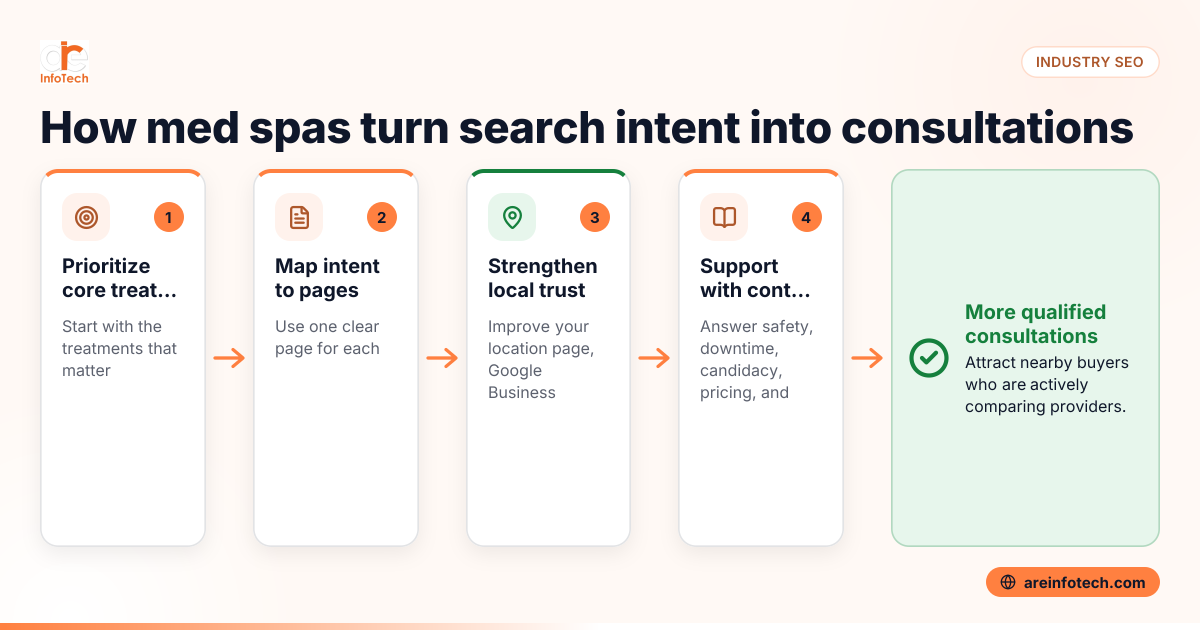
If you want a useful starting point, keep the process simple and focused.
Choose the treatments that matter most to your business. Build or improve those pages first.
Each major keyword should have one clear page target. Avoid making multiple pages compete for the same intent.
Improve your Google Business Profile, location page, and review generation process.
Create educational articles that answer booking-stage questions and link back to your treatment pages.
Improve speed, mobile usability, crawlability, and on-page SEO basics.
Review rankings, traffic, and consultations monthly. Double down on pages that are close to performing well.
Some patterns show up again and again.
If all treatments sit on one page, it is harder to rank for treatment-level searches.
If every location page uses nearly identical text, it is unlikely to perform well.
Publishing only educational blog posts can leave money on the table. You also need strong service and local pages.
Even a well-ranked page can underperform if the CTA is weak or hard to find.
Your treatment pages, blog posts, and location pages should support each other. Internal links help users and search engines.
If you want more practical SEO guidance by industry, browse the ARE InfoTech blog for examples of how strategy changes based on buyer behavior.
A med spa should hire an SEO agency when it has clear growth goals, limited internal bandwidth, and enough demand in its market to justify steady organic investment. The best time is often when your paid leads are expensive and you need a more durable source of consultations.
An agency can help if your team does not have time to manage keyword research, content planning, technical fixes, local SEO, and reporting. The right partner should talk about revenue goals, service priorities, and lead quality, not just rankings.
For med spas with multiple growth channels, SEO often works best alongside paid search, email follow-up, and strong front-desk conversion processes. SEO gets the right people to your site. Your team still needs to convert them well.
ARE InfoTech can help businesses build SEO systems around service pages, local intent, and lead generation goals. But even if you handle it in-house, the framework in this article will help you focus on the work that usually drives consultations.
If your med spa website gets traffic but not enough consultation requests, an SEO audit can show where the gap is. Review your treatment pages, local signals, content quality, technical SEO, and conversion path. Then fix the pages with the highest commercial intent first.
SEO usually takes time because rankings, authority, and local visibility do not improve overnight. Many med spas begin seeing early movement within a few months, but stronger consultation results often come from consistent work over a longer period.
Start with your highest-demand treatment pages and your primary location page. Those pages usually have the strongest revenue potential because they align with local commercial intent.
No. Blog content supports SEO, but it is rarely enough by itself. Most consultation-ready traffic comes from strong treatment pages, local pages, and a well-optimized Google Business Profile.
SEO and paid ads do different jobs. Paid ads can drive faster visibility, while SEO builds long-term organic demand and often lowers dependence on paid lead sources over time.
Google Reviews


