
Oct 10, 2026
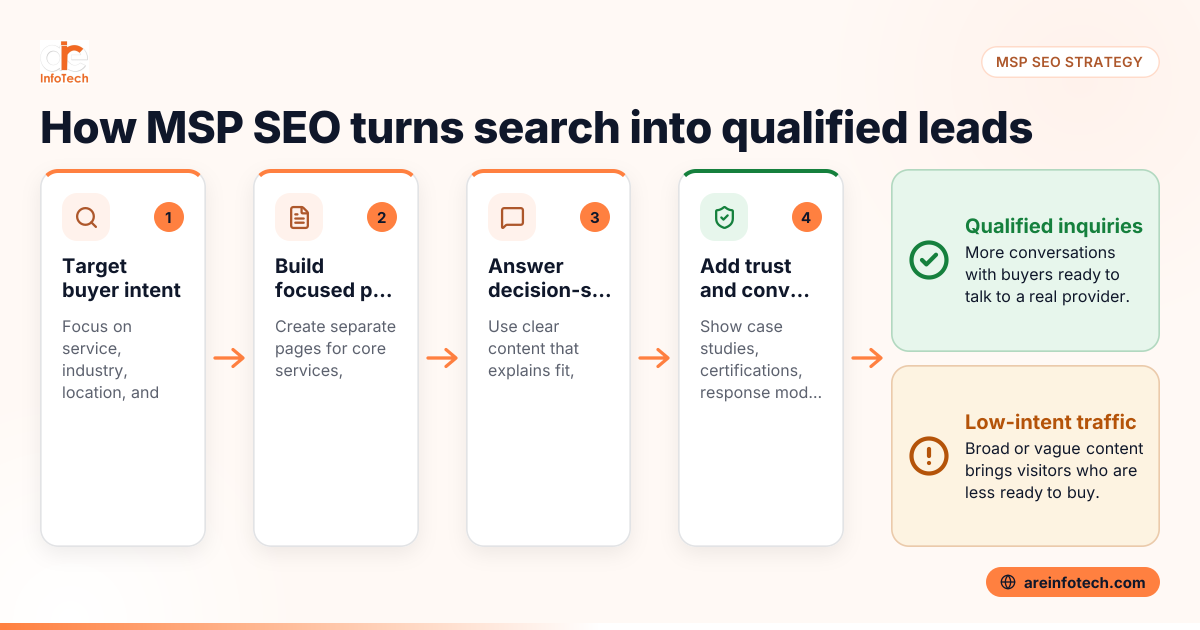
SEO for MSPs in United States means building search visibility for the services buyers already need, like managed IT, co-managed IT, help desk, cybersecurity, cloud support, and compliance support. The goal is not just more traffic. It is more qualified leads from businesses that are ready to talk to a real provider.
Most MSP buyers do not start by filling out a form. They start by searching. They look for terms like “managed IT services Chicago,” “co-managed IT Houston,” or “cybersecurity support for law firms Detroit.”
That search behavior creates an opportunity. If your MSP appears when a buyer has a real problem, you can enter the shortlist early. That matters because many business owners and IT leaders contact only a few providers before making a decision.
SEO also helps MSPs reduce dependence on referrals alone. Referrals are valuable, but they are hard to scale. Paid ads can work, but they stop when spending stops. SEO builds a steady pipeline of discovery over time.
For MSPs in the United States, this is especially important in competitive metro areas. Buyers often want a provider that understands local business conditions, onsite support expectations, vendor coordination, and compliance pressure. They also want confidence that your team can support common systems and business workflows.
A good SEO strategy helps your site show up for those high-intent searches. A better strategy helps the right buyers convert after they land on your site.
MSP SEO is different because the buyer is usually comparing risk, trust, responsiveness, and technical fit, not just price. Your website must help decision-makers understand what you solve, who you serve, and why your process is reliable.
An MSP sale often involves several stakeholders. A business owner may care about downtime and cost control. An operations leader may care about vendor coordination. An internal IT manager may care about co-managed support, escalation, documentation, and security standards. Your SEO content should speak to all of them.
MSP SEO also has a service complexity issue. Many firms lump everything into one “IT services” page. That is too broad. Search engines and buyers both need specificity. Separate pages should exist for:
This structure lets you rank for more relevant searches. It also improves conversion because each page can answer the exact concerns behind that service.
Qualified MSP leads usually come from service, industry, location, and problem-based keywords. Focus on terms that signal buying intent, not just broad informational traffic.
Examples include:
Start by grouping keywords into practical clusters. Each cluster should map to one main page or one content hub. That avoids cannibalization and keeps your site organized.
These are your money terms. They directly describe what you sell. Examples include managed IT services, co-managed IT, IT support company, and cybersecurity services.
These terms help attract businesses that want a provider with vertical experience. Examples include IT services for accounting firms, law firms, manufacturers, and dental practices. If you serve those niches, industry pages can work very well. Related strategy ideas also appear across the ARE InfoTech blog.
Even if you serve a wider region, local intent matters. Many buyers search with city names or “near me” variations. Build pages around real service areas, not thin doorway pages.
These attract buyers who may not know exactly what service they need. Examples include reducing downtime, ransomware protection, replacing an in-house IT person, or improving Microsoft 365 security.
Use a simple site structure with clear service pages, location pages, industry pages, and strong conversion paths. Each important search intent should lead to one focused page with one clear next step.
A practical structure often looks like this:
Your service pages should be the strongest assets on the site. Each page should explain:
Do not hide key details behind vague language. Buyers want specifics. If you offer co-managed IT, explain how your team works with in-house IT. If you provide cybersecurity, explain the categories of support you handle.
Industry pages are often high-converting for MSPs. A manufacturer, law firm, or dental office may prefer a provider that already understands its workflows, software stack, security concerns, and support expectations.
For example, a manufacturing company may care about ERP uptime, plant connectivity, and vendor coordination. A law firm may care about document security, email continuity, and access controls. A dental practice may care about imaging systems, scheduling software, and HIPAA-sensitive workflows.
If you create vertical pages, make them specific. Useful related examples include SEO for Machine Shops in United States: How to Get More RFQs from OEM Buyers, SEO for Law Firms in United States: How to Get More Qualified Case Evaluation Leads, SEO for Dental Practices in United States: How to Get More High-Intent Appointment Requests, and SEO for Accounting Firms in United States: How to Get More Tax, Bookkeeping, and CFO Service Leads.
A Chicago MSP should have a real Chicago page. A Houston provider should have a real Houston page. The same applies if you serve multiple metros.
Each page should include actual local relevance. Mention onsite support coverage, the business types you serve there, and examples of service delivery in that market. Avoid creating dozens of near-duplicate pages.
The best MSP content answers buyer questions before the sales call. It should build trust, reduce uncertainty, and show technical and operational understanding.
Good MSP content ideas include:
Many MSPs publish only general educational articles. Those can help, but they often attract low-intent traffic. You also need pages and posts built for decision-stage searches.
Examples include:
These topics speak to active buyers. They are closer to a sales conversation.
Search behavior is changing. Buyers now ask AI tools direct questions before visiting a website. That means ai seo matters for MSPs that want to stay visible.
To support AI-driven discovery, write pages with clear definitions, short direct answers, strong headings, and structured explanations. Put the plain answer first. Then expand with details. This helps both search engines and AI assistants understand your content.
A strong MSP service page should clearly explain the service, the fit, the process, and the next step. Buyers should know within seconds whether your team is relevant to their situation.
Include these elements:
Trust signals matter because MSP buyers are choosing a long-term operating partner. Useful trust signals can include:
If you support buyers with security reviews, vendor questionnaires, or procurement checks, say so plainly. Some U.S. buyers will ask about security expectations such as SOC 2 readiness from vendors in their ecosystem. If you can support that conversation, mention it accurately.
Do not overload the page with too many calls to action. Choose one main action. Examples include booking a consultation, requesting an IT assessment, or speaking with an engineer.
Use forms that ask only for essential details. Long forms can reduce response rates, especially on mobile.
Local SEO matters because many MSP leads still come from geographically specific searches. Even when service delivery is remote, buyers often want regional familiarity and optional onsite support.
Your Google Business Profile supports visibility in local search and map results. Keep your business name, phone, service categories, hours, and service areas accurate. Add real photos and keep business descriptions clear.
Reviews also matter. Ask satisfied clients for honest reviews. Do not script them heavily. Buyers can usually tell when reviews sound unnatural.
If you target Detroit, create a Detroit page with meaningful local content. Talk about the types of businesses you help there, your support coverage, and the kinds of IT issues common in that market.
Avoid city pages that just swap the place name. Thin pages rarely perform well for long.
Technical SEO will not fix weak positioning, but it helps strong pages get indexed, understood, and ranked.
Focus on these basics:
Internal links help search engines understand page relationships. They also help users move from educational content to service pages.
For example, a blog post about cybersecurity risk can link naturally to your managed security page. An article about vertical growth can link to industry-focused content like SEO for HVAC Companies in United States: How to Get More Service Calls and Estimate Requests or SEO for Plastics Manufacturers in United States: How to Get More RFQs for Injection Molding, Extrusion, and Custom Parts. That kind of structure helps users and search engines.
Most MSPs should expect SEO to take several months before meaningful lead growth appears. Faster gains can happen when you fix major site issues, improve service pages, and target lower-competition local terms first.
The timeline depends on competition, site quality, location, domain history, and how much useful content you publish. In many cases, the first wins come from better conversion on existing traffic, not rankings alone.
A reasonable approach is to measure progress in stages:
MSP SEO often fails when firms chase traffic instead of qualified demand. It also fails when websites stay vague, generic, or too broad.
Common mistakes include:
Another major issue is weak differentiation. If every page says “trusted IT partner” and “tailored solutions,” buyers learn nothing. You need concrete language. Explain what you do, who you help, how support works, and why your process reduces risk.
If you want a practical starting point, follow this order.
Define your top services, top industries, and top geographies. Be specific.
Create or improve pages for managed IT, co-managed IT, cybersecurity, cloud, and your best industries.
Improve your Google Business Profile and build real city pages for the markets you serve.
Answer buyer questions that support deals. Focus on switching, onboarding, risk, pricing factors, and service comparisons.
Make forms simple. Add stronger trust signals. Clarify your process.
Measure not just traffic, but qualified calls, meeting requests, and sales opportunities.
If you want outside help, ARE InfoTech can support SEO strategy and execution. But even before hiring anyone, this framework will help you see what is missing.
If your MSP website gets traffic but not enough qualified leads, an SEO audit can show where the gap is. Review service pages, keyword targeting, local visibility, content quality, technical issues, and conversion paths. The right audit should tell you what to fix first, what to build next, and what will likely improve lead quality fastest.
SEO and paid ads do different jobs. Paid ads can create faster visibility, while SEO builds long-term discovery and trust. Many MSPs use both, but SEO often produces stronger economics over time when service pages and local targeting are done well.
Google Reviews


