
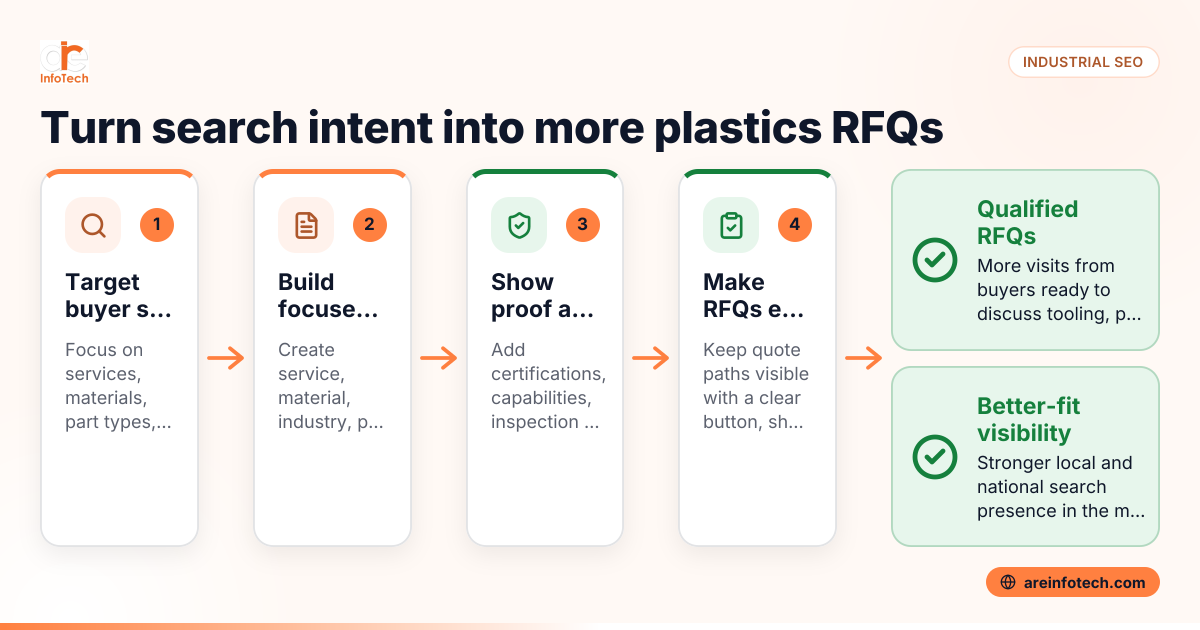
SEO for plastics manufacturers in United States is the process of making your website easier to find when buyers search for molding, extrusion, thermoforming, tooling, and custom plastic part suppliers. Done well, it brings in more qualified RFQs, better-fit OEM buyers, and stronger visibility in the regions and industries you want to serve.
Plastic component buyers rarely search in broad, vague ways. They search for very specific manufacturing needs. A procurement manager may search for “injection molding supplier Chicago,” “custom ABS housing manufacturer,” or “plastic extrusion company for medical tubing.” An engineer may search by material, tolerance, process, part type, or production volume.
That is why SEO for plastics manufacturers United States should focus on commercial intent. You do not need random traffic from people reading general plastics articles. You need purchasing teams, product engineers, plant managers, and sourcing professionals who are ready to request pricing, discuss tooling, or qualify a new supplier.
For many manufacturers, search also supports long sales cycles. A buyer may visit your site several times before sending an RFQ. They may compare your capabilities, certifications, production capacity, quality systems, lead times, and secondary services. If your site does not answer these questions clearly, they move on.
SEO also creates a compounding advantage. A trade show ends. Paid ads stop when spend stops. But a strong search presence can keep bringing in RFQs month after month. That makes it valuable for custom injection molders, extrusion shops, thermoformers, blow molders, and plastics fabricators across the United States.
You should rank for the exact services, materials, part types, industries, and locations your ideal buyers search when they need a supplier. Focus on commercial-intent keywords tied to RFQs, not broad educational terms alone.
Start with the pages that map to buying intent. Most plastics manufacturers need a search strategy built around several keyword groups.
These are your main revenue-driving searches. Examples include:
If you offer design support, tooling management, assembly, or finishing, those should also have dedicated pages.
Many buyers search by resin or substrate. Examples include:
Material pages work well because they match engineer search behavior. They also help buyers evaluate whether you understand application requirements.
Buyers often search for the part they need, not the process behind it. Examples include:
These pages can bring highly qualified traffic. They also help you connect your process knowledge to real end uses.
If you serve regulated or specialized markets, create pages around them. Examples include:
This is often where trust matters most. Buyers in these sectors want clear quality systems, process controls, and production discipline.
Even national suppliers benefit from geographic relevance. A buyer in Houston may still prefer a Texas supplier. A sourcing manager in Detroit may search for a Midwest molding partner. Build pages around:
Do not create weak location pages with thin content. Each one should show why a buyer in that area should contact you.
Use focused service pages, clear trust signals, and fast RFQ paths. Buyers should understand your capabilities in seconds and reach quoting in one step.
Traffic alone is not enough. Many manufacturing websites get visits but fail to generate quote requests because the site does not support buyer decision-making. Your pages should help visitors answer a simple question: “Can this supplier make my part reliably?”
Each major process deserves its own page. For example:
Each page should explain:
Avoid generic claims. Specificity wins.
Your RFQ path should be visible on every important page. Good RFQ options include:
If buyers need to upload 3D models or technical drawings, note that clearly. If you support NDAs, mention that. Engineers and sourcing teams want a low-friction next step.
Manufacturing buyers look for evidence before they contact you. Helpful trust elements include:
If you work with OEMs, contract manufacturers, or product companies, say so in plain language.
A strong plastics manufacturing SEO program usually starts with page structure. Many companies have a homepage, an about page, and a contact page. That is not enough to rank for high-intent manufacturing searches.
Create one page per major process. Do not combine everything into one generic capabilities page. Search engines and buyers both prefer focused content.
If you commonly work with ABS, polypropylene, HDPE, nylon, polycarbonate, PVC, or acrylic, build pages around those materials. Explain why they are used, common applications, and what your production team can handle.
If you serve medical, automotive, industrial, consumer goods, or electronics, create pages for each. Tie your processes to industry needs.
These pages target searches like “custom plastic housings” or “plastic tubing extrusion supplier.” They often convert well because intent is specific.
If you want business in Illinois, Texas, Michigan, or California, create useful pages for those markets. Mention shipping reach, typical customer types, and regional support if accurate.
Not every page should be sales-first. Resource content helps buyers earlier in the process. It also supports internal linking and topical authority. A few useful examples:
For more practical search content ideas, readers can also browse the ARE InfoTech blog.
The best content answers real sourcing and engineering questions tied to process, material, quality, and quoting. It should move a buyer closer to sending drawings or discussing production.
This is where many industrial companies miss the mark. They publish broad content that gets visits but not leads. For plastics manufacturing, the best content sits near the buying decision.
Good topics include:
These articles should link naturally to service pages and RFQ pages.
Comparison pages work well when buyers are evaluating options. Examples include:
Keep these pages practical and honest. Buyers can spot filler content immediately.
Search behavior is changing. More buyers ask full questions instead of typing short keywords. That is where ai seo becomes useful. It helps structure pages around direct answers, supporting details, and strong page entities so search systems can understand your capabilities more clearly.
That does not mean writing robotic content. It means creating pages that answer buyer questions fast, then back them up with technical depth.
On-page SEO helps search engines understand each page and helps buyers decide whether to stay on it. For industrial sites, clarity matters more than clever wording.
Your page title should include the main service and, when useful, a location or application. Example:
Your meta description should promise the value of the page in plain English. Focus on capabilities, materials, industries, and quoting.
Use one main topic per page. Then organize details with clear subheads such as:
This helps users scan quickly. It also supports search understanding.
Link between related pages. For example, an extrusion page should link to material pages, quality pages, and RFQ pages. If you serve industrial manufacturing buyers, you may also find ideas in SEO for Machine Shops in United States: How to Get More RFQs from OEM Buyers.
Photos of your facility, machines, finished parts, tooling process, or inspection setup can improve trust. So can diagrams, capability charts, and process visuals.
Even good content can struggle if the website has technical problems. Many plastics manufacturing sites are built on old platforms and have slow load times, weak mobile usability, or confusing navigation.
Look for:
Search engines need to discover, crawl, and understand your site. Make sure your main pages are linked from navigation, category pages, and relevant body content.
Even in B2B manufacturing, many first visits happen on phones. A plant manager or buyer may check your site from the shop floor, a meeting, or during travel. Your forms, phone number, and core value proposition should work well on mobile.
Local SEO is not just for restaurants or dentists. It matters for industrial companies too, especially if your buyers prefer nearby suppliers for logistics, plant visits, or faster communication.
Make sure your name, address, phone number, website, and service category are accurate everywhere they appear. Consistency matters.
If you want to win searches in Chicago, Houston, Detroit, or surrounding industrial markets, create useful regional pages. Include real operational context, such as industries served in that area or shipping coverage.
Useful sources may include:
Focus on relevance, not volume.
Manufacturers should not judge SEO by traffic alone. The real goal is qualified pipeline. That means you need to measure what happens after the click.
Pay attention to:
Talk to your sales team. Ask which leads were a good fit. Find out which pages those leads visited. Over time, this helps you invest in pages that generate real opportunities.
If your team uses forms tied into QuickBooks, Stripe invoicing workflows, or CRM tools for quoting follow-up, make sure your attribution setup captures source data cleanly.
If you want a simple path forward, start with this order of operations.
Review technical issues, page structure, rankings, and conversion paths.
Prioritize processes, materials, industries, and part types tied to revenue.
Start with injection molding, extrusion, custom parts, and your strongest verticals.
Show capabilities, quality systems, industries served, and easy quote options.
Answer real buyer questions and link back to service pages.
Use conversion tracking and lead review to improve over time.
A specialized partner can help if your internal team lacks time or industrial SEO experience. ARE InfoTech can support planning and execution, but the key is having a strategy centered on buyer intent and RFQs.
If your plastics manufacturing website gets traffic but too few RFQs, an SEO audit can show where the leaks are. Review your service pages, technical issues, keyword targeting, internal links, and RFQ path. Then fix the gaps in the order that improves lead flow fastest.
Most manufacturers should expect SEO to take several months before meaningful gains appear. The timeline depends on your current site, competition, and how much high-intent content already exists. Strong pages and technical fixes can improve results sooner.
SEO and paid ads serve different roles. Paid ads can create faster visibility, while SEO builds long-term search presence and lowers dependency on ongoing ad spend. For many manufacturers, SEO becomes more cost-effective over time.
Yes. These services match different buyer searches and different technical needs. Separate pages make it easier to rank, easier to explain capabilities, and easier for buyers to self-qualify before sending an RFQ.
Google Reviews


