
Oct 09, 2026
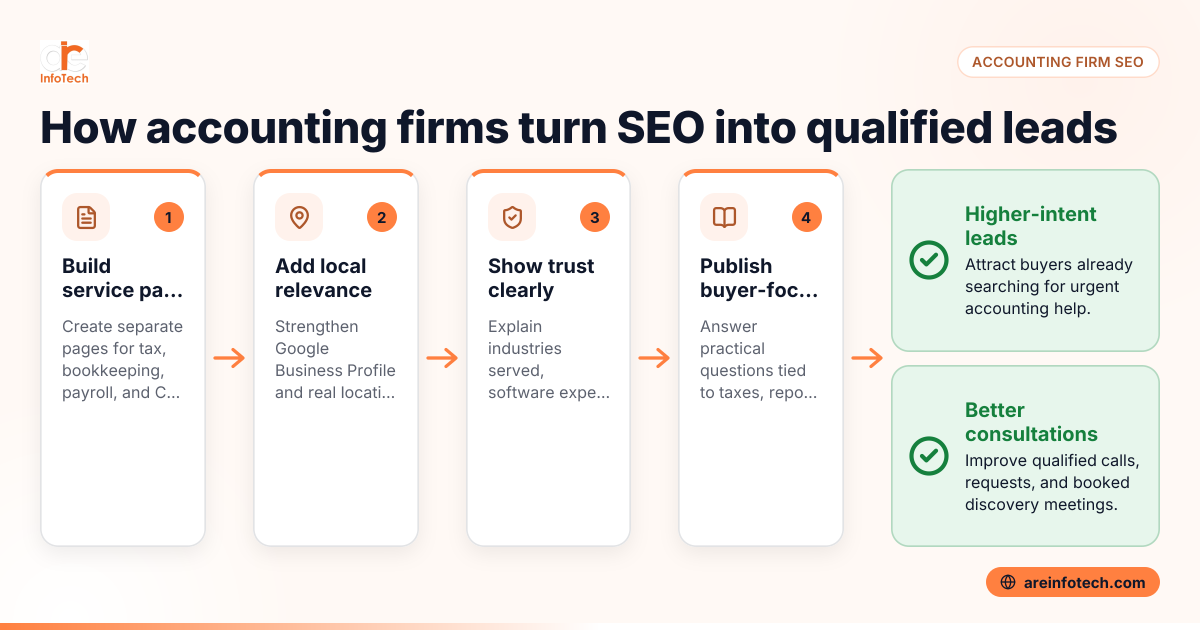
SEO for accounting firms in United States means improving your website, local presence, and service pages so business buyers can find you when they need tax, bookkeeping, payroll, CAS, or outsourced CFO help. Done well, it brings in higher-intent leads from companies already searching for an accountant, not just browsing.
Most accounting buyers do not start by filling out a long RFP. They search online when a problem becomes urgent.
A business owner in Chicago may need catch-up bookkeeping before meeting a lender. A contractor in Houston may need quarterly tax planning. A manufacturing company in Detroit may be looking for a part-time CFO who understands margins, inventory, and ERP reporting.
These searches are high intent. The buyer already knows the problem. They are now comparing firms.
That is why SEO for accounting firms in United States can become a dependable lead channel. It helps your firm appear when people search for services like:
SEO also helps before the lead form. It shapes trust. Buyers want to know whether you understand their industry, tax concerns, software stack, and reporting needs. Your site should answer those questions fast.
Accounting is a trust-heavy service. Buyers are not just looking for traffic. They are choosing who will handle sensitive financial data, tax deadlines, payroll accuracy, and management reporting.
That changes what your SEO strategy should emphasize.
Your pages should show real business value. Explain what you do, who you serve, what systems you work with, and what the first step looks like.
For example, an outsourced CFO page should mention the problems you solve, such as:
A tax page should explain whether you support business returns, estimated taxes, year-end planning, and 1099 processes.
A blog about “what is bookkeeping” may bring visits, but it may not bring many qualified leads.
A page about “bookkeeping services for restaurants in Chicago” or “fractional CFO for manufacturing companies” usually has stronger buyer intent.
That does not mean educational content has no value. It means service pages should come first.
Many firms serve a metro area. Others serve clients across several states. In both cases, searchers often include a location or industry in the query.
Good accounting SEO often combines these dimensions:
Start with high-intent service pages, your Google Business Profile, and local trust signals. Then build industry pages, useful content, and technical fixes. Most firms get better results by tightening what already exists before publishing dozens of blog posts.
The first goal is not “more content.” It is clearer relevance.
If your homepage tries to rank for tax, bookkeeping, payroll, CFO services, and every industry at once, it will usually underperform. Buyers need dedicated pages that match the service they searched for. Search engines do too.
Start with the pages most tied to revenue. For many firms, those are tax, bookkeeping, payroll, advisory, and outsourced CFO pages. Then add location and industry support where it reflects your actual business.
A practical SEO plan for accounting firms has five parts.
Create a dedicated page for each main offer. Avoid combining everything into one generic “services” page.
Examples include:
Each page should explain:
Use plain language. Business buyers care about outcomes. They want to know if you can reduce errors, improve reporting, keep filings on track, and support decisions.
Industry pages help you show fit. This is useful because business accounting needs vary a lot.
A law firm may care about trust accounting and partner reporting. A dental practice may care about collections, payroll, and expansion planning. A machine shop may care about job costing, inventory, margins, and ERP data.
If you serve specific sectors, build pages around them. Make them real, not thin copy.
A good industry page can cover:
This also helps internal linking. If your firm serves adjacent professional service markets, content such as SEO for Law Firms in United States: How to Get More Qualified Case Evaluation Leads or SEO for Dental Practices in United States: How to Get More High-Intent Appointment Requests shows how niche service pages can map to high-intent buyers.
Even if you work remotely, local visibility still matters. Many buyers search for accountants near them because they want a firm that understands their state requirements, business environment, and time zone.
Focus on:
If you have offices in multiple cities, create unique pages for each location. Do not duplicate copy and just swap city names.
Blog content should support the services you sell.
For accounting firms, useful topics include:
This kind of content helps both classic SEO and ai seo because it answers direct business questions in a clear format. It also gives you assets to link from service pages.
For topic ideas and publishing patterns, readers can also browse the ARE InfoTech blog.
A beautiful site can still underperform if it has weak technical foundations.
Check for:
For accounting firms, mobile matters because many searches happen when owners are traveling, in meetings, or dealing with deadlines. Your key pages should load fast and make it easy to call or request a consultation.
Match pages to urgent buyer searches, show clear expertise, and remove friction from contacting you. Rankings help, but conversions come from relevance, trust, and a simple next step.
A lead is only useful if it fits your firm. That is why accounting SEO should filter as well as attract.
Many firms say they serve everyone. That usually weakens SEO and lead quality.
Instead, define:
Then reflect that in page copy. If you work with growing companies between $1 million and $20 million in annual revenue, say so. If you help ecommerce companies reconcile QuickBooks and Stripe, say that too.
This improves both rankings and lead quality.
“Contact us” is weak on service pages.
Better calls to action include:
The CTA should fit the page topic. It should also set expectations. Buyers want to know what happens next.
Trust elements can include:
If your buyers often compare platforms, your site structure also matters. Articles such as HubSpot vs WordPress for Small Business Websites in United States: Which Is Better for SEO, Leads, and Ownership? can help firms think through website control and SEO flexibility.
Publish service-led content that answers real buyer questions around taxes, bookkeeping, reporting, payroll, and CFO support. Focus on topics that move a visitor toward a consultation, not just general education.
Once your core service and location pages are built, use content to support them.
Consider topics like:
These topics help buyers understand the problem and see your firm as a practical option.
To improve visibility in search results and AI-generated answers:
This structure helps traditional rankings and makes your pages easier for AI systems to quote accurately.
Local SEO is not just for walk-in businesses. It matters for accounting firms because buyers still search by city, county, or metro area.
If you have one office, optimize around that primary market.
Build pages around:
For example, a Chicago accounting firm may want pages around business tax, bookkeeping, and CFO services for local professional services and wholesalers.
If you have several offices, give each location a distinct page with local relevance.
Include:
Avoid doorway pages. They usually perform poorly and create a weak user experience.
A lot of accounting websites fail for simple reasons.
Phrases like “trusted advisors” and “personalized solutions” are common. They do not explain what you actually do.
Replace them with specific language about services, industries, software, and deliverables.
If your firm offers multiple revenue lines, each needs its own page. Otherwise, you force every visitor into the homepage.
If you want to rank for accounting services in Houston or bookkeeping for contractors, your site needs content that supports that intent.
Random posts rarely drive strong leads. Every article should support a service, industry, or location page.
SEO does not end at traffic. A service page needs a clear CTA, usable form, and direct phone option.
Do not judge SEO only by rankings. Measure whether it produces qualified opportunities.
Track:
If possible, connect SEO outcomes to revenue categories like tax, bookkeeping, payroll, and CFO services. That helps you see which pages drive the best business, not just the most clicks.
A firm may find that a lower-traffic outsourced CFO page drives more revenue than a broad bookkeeping article. That is useful insight.
If your accounting firm wants a practical starting point, use this sequence.
If you want expert help, ARE InfoTech can support accounting firms that need a clearer SEO structure, stronger service pages, and a lead-focused growth plan.
If your accounting firm is getting traffic but not enough qualified tax, bookkeeping, or CFO leads, an SEO audit can show where the gap is.
A useful audit should review:
The goal is not a bigger report. The goal is a clearer plan. You should leave with a list of actions that can improve rankings, trust, and lead flow.
Most firms should expect SEO to take several months before meaningful lead growth appears. Small improvements can happen sooner, especially from service page updates, local SEO fixes, and better calls to action.
Google Reviews


