
Oct 11, 2026
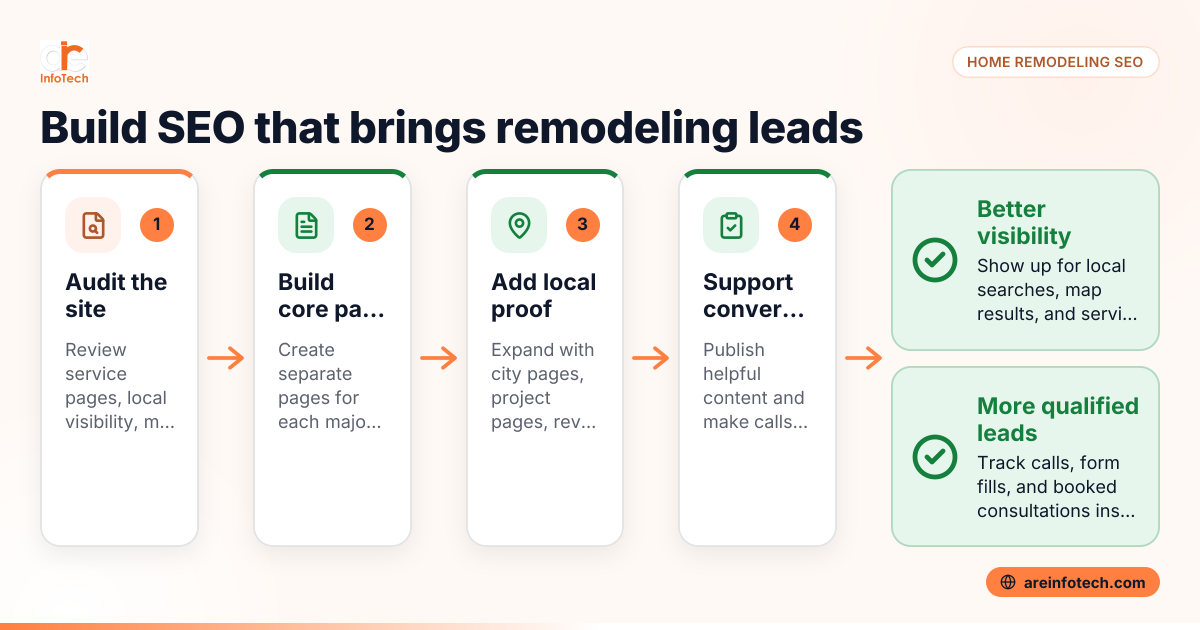
SEO for home remodeling contractors helps your company show up when homeowners search for kitchen remodels, bathroom renovations, additions, and whole-home projects in your service area. In the United States, strong SEO brings in more qualified leads by improving your visibility in local search, map results, and service pages tied to real project intent.
Most homeowners do not wake up and search for a general phrase like "contractor." They search for a specific project, a specific area, and often a specific budget level. They want to see whether you handle the kind of work they need.
That is why SEO for home remodeling contractors should focus on intent. A homeowner in Chicago searching for "kitchen remodeling contractor near me" is much closer to requesting an estimate than someone reading broad home design ideas.
In the United States, this matters even more because remodeling projects are high-value purchases. Homeowners compare portfolios, read reviews, check your service area, and often contact two to five companies before deciding who to invite for a consultation.
Good SEO helps you win earlier in that process. It puts your company in front of the right homeowner before directories and paid ads take all the attention.
A strong SEO strategy can help you generate leads for:
If your site only has a homepage and a contact page, you are likely missing many of these searches.
SEO for home remodeling contractors includes local keyword targeting, service page optimization, technical site improvements, content creation, review generation, and conversion tracking. The goal is simple: rank for services homeowners search for in your area and turn that traffic into consultation requests.
Under that short answer, the practical work is more detailed. Remodeling SEO is not one task. It is a system.
Start with how homeowners search in your market. They may use:
Look for keywords by service and by city. A contractor serving Detroit and nearby suburbs needs different page targeting than one serving a single metro neighborhood.
Each major service needs its own page. Do not bury everything under one generic "services" page.
Create separate pages for:
Each page should explain your process, ideal project types, service area, timeline expectations, and proof of work.
Your Google Business Profile, local citations, review profile, and city relevance all affect visibility. Many remodeling leads come from map pack results, especially on mobile.
Your website needs to load fast, work on phones, and make every key page easy to crawl. Many contractor sites lose rankings because they use heavy image files, weak page structure, or poor internal linking.
Traffic alone is not enough. Your pages should make it easy for people to call, request a consultation, or submit a project inquiry.
At minimum, build separate pages for each core service, your main service areas, project gallery pages, an about page, and clear contact pages. Add content only if it supports a real search need or a homeowner decision.
Now expand that into a practical site structure.
These are usually your highest-value SEO assets. Each should target one service and one main search theme.
Examples:
Do not combine kitchen, bath, and additions into one thin page. That makes it harder to rank for any one service.
If you work across a metro area, city pages can help when they are useful and specific. A page for "Kitchen Remodeling in Chicago" should not be a copy-paste version of "Kitchen Remodeling in Naperville."
Good city pages include:
These are critical in remodeling. Homeowners want proof.
Strong project pages include:
These pages can rank, support service pages, and improve conversion rates.
Homeowners often want to know who they are hiring. A clear process page and an about page help build trust. If you offer financing through approved providers, explain the process clearly without making claims you cannot support.
They usually search by project type, location, and urgency. Many searches include words like near me, contractor, company, remodeler, renovation, or design build.
That behavior should shape your SEO plan.
A homeowner may search:
Notice the pattern. These are not broad educational searches. They are commercial intent searches.
Kitchen and bathroom searches are often more competitive because they are common project types. Whole-home remodels may have lower search volume but much higher project value.
A smart strategy balances both.
For example:
Remodeling is a trust-heavy category. Even if two pages target the same keyword, the one with stronger photos, better examples, and clearer process details may convert much better.
This is where content and SEO overlap. Your site needs to rank, but it also needs to persuade.
For many contractors, local SEO drives the most immediate lead flow. Homeowners often search on their phones, compare map listings, and call directly from the search results.
Your profile should include:
Keep your information consistent with your website.
Reviews affect both rankings and conversions. Ask happy clients for reviews after key milestones or after project completion. Make the ask simple and personal.
Do not try to game the system. Focus on real feedback from real customers.
If your Google Business Profile says you serve certain areas, your site should support that with city pages, project examples, and local references.
A remodeler serving Chicago's suburbs should not rely on a single homepage to rank everywhere.
Content should help homeowners make decisions, not just fill your blog with generic articles. The best content supports buyer questions and connects back to your services.
Consider topics like:
These topics can attract early-stage leads and move them toward a consultation.
Your blog should strengthen your money pages. A blog post about kitchen remodel timelines should link to your kitchen remodeling service page.
If you want more ideas on practical search strategy, the ARE InfoTech blog has useful posts across different industries.
Many remodeling companies overlook this. A completed project can become one of your strongest content assets.
Turn each good project into a page that supports SEO and sales. Show the homeowner problem, the approach, the result, and the final visuals.
A strong page should explain your service, show real project proof, define your service area, answer common homeowner questions, and make contacting you easy. It should be written for both search engines and real homeowners comparing contractors.
Here is a simple structure that works.
Include:
Do not publish a 200-word page with a stock photo and a form. That will struggle to rank and convert.
Kitchen and bath buyers often look for:
If you handle these, say so clearly.
Many remodeling websites lose leads because of basic technical issues. These are often easy to fix, but they can hurt rankings and user experience.
Watch for:
Many homeowners start on a phone. If your gallery is hard to load or your contact form is difficult to use, you may lose the lead before they ever speak with you.
Set up tracking for:
If you use QuickBooks or Stripe in your business operations, keep your marketing reporting separate enough to measure true lead sources clearly. Closed revenue matters, but first you need clean lead attribution.
AI SEO can speed up keyword research, content briefs, page outlines, and FAQ drafting, but it should not replace your project knowledge, photos, or local expertise. Use it to support execution, not to mass-produce generic pages.
That matters because many contractors hear about AI and assume it will solve lead generation by itself. It will not.
It can help with:
It cannot replace:
If every page sounds machine-written and generic, homeowners will notice. Search engines may also struggle to see your site as distinct.
The best use of ai seo is operational efficiency. Let it help your team move faster, but keep the final content grounded in your real work.
If you want leads, you need a plan that prioritizes high-intent pages first. Start with the pages that can drive consultations soonest.
Review:
Find gaps first. Do not start publishing random content without a map.
Focus first on:
These usually represent both search demand and strong project value.
Once service pages are solid, expand into the locations and project examples that support them.
Work on reviews, local photos, citation consistency, and project proof tied to your service area.
Answer buyer questions that help move homeowners toward a consultation. If your audience includes specialty or operational buyers in adjacent sectors, you can also study how local SEO is approached in examples like SEO for Plastics Manufacturers in United States: How to Get More RFQs for Injection Molding, Extrusion, and Custom Parts or SEO for ERP Software Companies in United States: How to Generate More Demo Requests From Manufacturing Buyers. The industries differ, but the lesson is similar: high-intent pages win.
Measure what happens after the click. Which pages generate calls? Which cities convert best? Which services bring the most qualified jobs?
SEO should improve over time through real sales feedback.
You should consider hiring help when your market is competitive, your website is outdated, or your team cannot execute consistently. The right support should help you prioritize lead-generating work instead of chasing traffic that does not turn into projects.
An agency can help if:
A good partner should talk about lead quality, not just rankings. For a remodeling contractor, ranking first for a vague keyword means little if the leads are outside your service area or budget range.
ARE InfoTech can help businesses build practical SEO systems focused on service pages, local visibility, and conversion paths. The useful test is simple: does the strategy help you book more qualified consultations?
If your remodeling company wants more kitchen, bath, and whole-home project leads, start with an SEO audit. Review your service pages, local rankings, Google Business Profile, project content, and conversion tracking before investing in more content or ads.
A good audit should show:
Google Reviews


