
Oct 11, 2026
SEO for roofing contractors in United States means making your company easier to find when local homeowners and property managers search for roof repair, replacement, inspections, and storm damage help. Done well, it brings in more estimate requests from people already looking for a roofer, instead of relying only on referrals, yard signs, or paid ads.
Roofing is a high-intent service. Most people do not browse for fun. They search when they have a leak, visible damage, an insurance question, or a planned replacement. That makes search engine traffic valuable.
For a roofing contractor in Houston, Chicago, or Detroit, search demand usually falls into a few buckets:
If your business shows up well for these searches, you can attract leads close to the moment of decision. That matters because roofing buyers often contact only a small number of companies before choosing who gets the estimate.
SEO also compounds. A strong page can generate calls and estimate requests for months, unlike paid campaigns that stop when the budget stops. For roofing companies with a sales team, canvassing effort, and seasonal demand swings, SEO can create a steadier lead source.
Roofing has a few traits that make the strategy different.
First, urgency is common. Someone with an active leak wants help now. Your pages need clear calls to action, visible phone numbers, and trust signals near the top.
Second, service areas are broad. A roofer may serve one city plus many suburbs. That requires careful city-page planning without creating thin, duplicate content.
Third, seasonality matters. Storms, hail, wind events, and winter damage can create sudden spikes in searches. If you wait to publish until after demand peaks, you lose the window.
Fourth, competition is intense. Many roofing markets have aggressive advertisers, directory sites, and lead aggregators. You need better local relevance and stronger pages, not just more keywords.
Finally, trust is everything. Homeowners are inviting a contractor onto their property for a major purchase. Reviews, project photos, certifications, licensing details where applicable, financing information, and clear process explanations all help conversion.
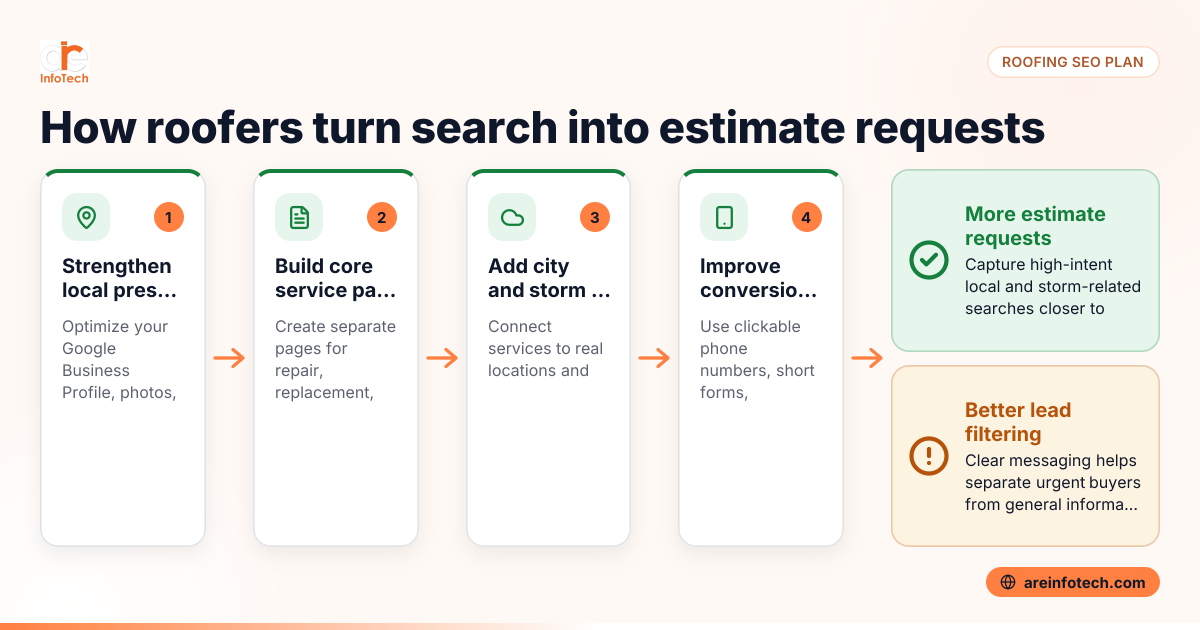
Focus on Google Business Profile, city and service pages, reviews, and fast mobile conversion. Then support that with technical SEO, useful content, and clear proof that you do roofing work in the areas you target.
That short answer is the core of the plan. Many roofers overcomplicate SEO and ignore the basics that move leads.
Start with your Google Business Profile. Keep the business name, phone number, hours, categories, service areas, and photos accurate. Add fresh project photos, answer questions, and request reviews consistently. For many roofers, local map visibility drives a large share of calls.
Next, build strong service pages. Do not rely on a single “roofing services” page. Separate pages for roof replacement, roof repair, roof inspection, storm damage repair, commercial roofing, and emergency tarping can rank for clearer intent.
Then add city and suburb pages where you truly work. Each page should include local proof, such as project types, neighborhood references, weather concerns, and common roofing materials in that area. A page for Naperville should not read like a page for downtown Chicago.
Finally, improve conversion paths. Make the phone number clickable. Keep forms short. Offer estimate scheduling. Show license and insurance details where relevant. Explain what happens after submission. Better conversion means more leads from the same traffic.
Many roofing websites are too thin. They have a homepage, an about page, and a contact page, then expect to rank for every service in every city. That usually does not work.
A stronger site structure looks like this:
Your homepage should clearly state:
It should also link to major services and locations.
Create individual pages for services such as:
Each page should explain the service, warning signs, process, roofing materials, timelines, and when to request an estimate.
If you serve multiple cities, create pages for each meaningful service area. Do not create dozens of near-identical pages just to stuff keywords. Build only the pages you can support with real local relevance.
These pages deserve special attention because they can attract urgent, high-value leads. Create pages around storm damage repair, insurance-related inspection support, and emergency response.
Include pages for reviews, project galleries, financing details, warranties, and FAQs. These pages help both SEO and conversion.
A good internal linking structure ties all of this together. Your service pages should link to related city pages. Your city pages should link back to the main service pages. Your blog content should support both.
Target keywords with clear buying intent, local intent, and storm-related urgency. Good examples include “roof repair in [city],” “roof replacement contractor near me,” and “hail damage roofing company in [city].”
From there, build a keyword map. Group terms by service, location, and intent instead of chasing hundreds of disconnected phrases.
These often convert best:
These are important in weather-driven markets:
These may not convert immediately, but they build trust:
If you want to expand into educational content strategy, reviewing examples on the ARE InfoTech blog can help you see how service businesses structure SEO content for lead generation.
Roofing companies often publish broad blog posts that get visits but few leads. Better content matches real sales questions and local demand.
Good topics include:
These topics help buyers move toward a decision.
When major hail or wind events hit, search demand rises fast. Create or update pages tied to the affected metro and service need. Keep the content useful and factual. Avoid sounding exploitative.
Examples include:
Before-and-after photos, roofing material details, neighborhood references, and common repair scenarios add credibility. They also make your content less generic.
An ai seo process can speed up outlines, topic clustering, FAQ drafting, and schema planning. But roofing content still needs a real editor who knows local service areas, storm patterns, and what your crews actually do. If not, you risk publishing vague pages that do not rank or convert.
For many roofers, Google Business Profile is the highest-leverage local asset after the website itself.
Make sure these basics are right:
Upload photos of completed roofs, materials, crews, trucks, and close-ups of workmanship. Fresh visuals help prospects trust the business.
Request reviews after inspections, repairs, and completed replacements. Ask customers to mention the service and city naturally. Do not script fake-looking language.
Reply professionally to both positive and negative feedback. This shows activity and trustworthiness.
Share updates about seasonal inspections, storm response availability, or financing promotions if applicable. Add common questions and answer them clearly.
Technical SEO is not the first thing a roofer should fix, but it matters once the basics are in place.
Most emergency roofing searches happen on phones. Your site should load fast, show the phone number immediately, and keep forms simple.
Make sure search engines can find your important pages and ignore weak ones. Thin tag pages, duplicate city pages, and old campaign URLs can dilute performance.
Local business, service, FAQ, and review-related structured data can help search engines understand your pages better. Keep it accurate.
You need to know which pages drive calls and forms. Set up form tracking, call tracking where appropriate, and lead source reporting in a simple dashboard. If your team already uses tools like QuickBooks and Stripe on the business side, treat marketing reporting with the same discipline. Clean inputs lead to better decisions.
Build storm pages before peak season, update them fast after severe weather, and connect them to local proof, urgent calls to action, and inspection-focused offers.
Storm damage SEO works best when the foundation already exists. Do not wait for a storm to create your first hail damage page.
This matters because storm leads can be high volume but uneven in quality. Some people need real help now. Others are just gathering information. Clear messaging helps filter both.
Roofing is a trust-heavy category. Search engines and buyers both look for evidence that your company is legitimate and active.
A steady flow of recent reviews is better than occasional bursts. Ask happy customers soon after work is completed. Mentioning the type of job helps future buyers.
Keep your business name, address, and phone consistent across major business listings and local directories. Inconsistency can weaken local trust.
Useful ways roofers earn links include:
Add:
If your company also markets to commercial property owners or manufacturers, the structure used in SEO for ERP Software Companies in United States: How to Generate More Demo Requests From Manufacturing Buyers is a good reminder that B2B buyers also respond to clear service pages, proof, and intent-focused content.
Rankings matter, but they are not the main goal. Estimate requests, phone calls, inspection bookings, and closed revenue matter more.
A page may bring fewer visits but more booked inspections. That page is often more valuable than a blog post with lots of low-intent traffic.
Roof replacement, repair, and storm work may perform differently. Break results out by category so you know where to invest.
A roofer serving several cities should measure each area separately. What works in a dense suburb may not work in a nearby rural county.
Swapping city names into the same copy rarely works. Each page should offer real local value.
If the site ranks but users cannot call or request an estimate easily, traffic is wasted.
General roofing tips with no local relevance or buying intent rarely help much.
Many roofers underuse one of the strongest local lead channels.
You do not need every click. You need the right clicks from people who want estimates.
AI tools can help with speed, but low-quality mass content often creates cleanup work later.
If you want a practical roadmap, start here.
Google Reviews


