
Oct 11, 2026
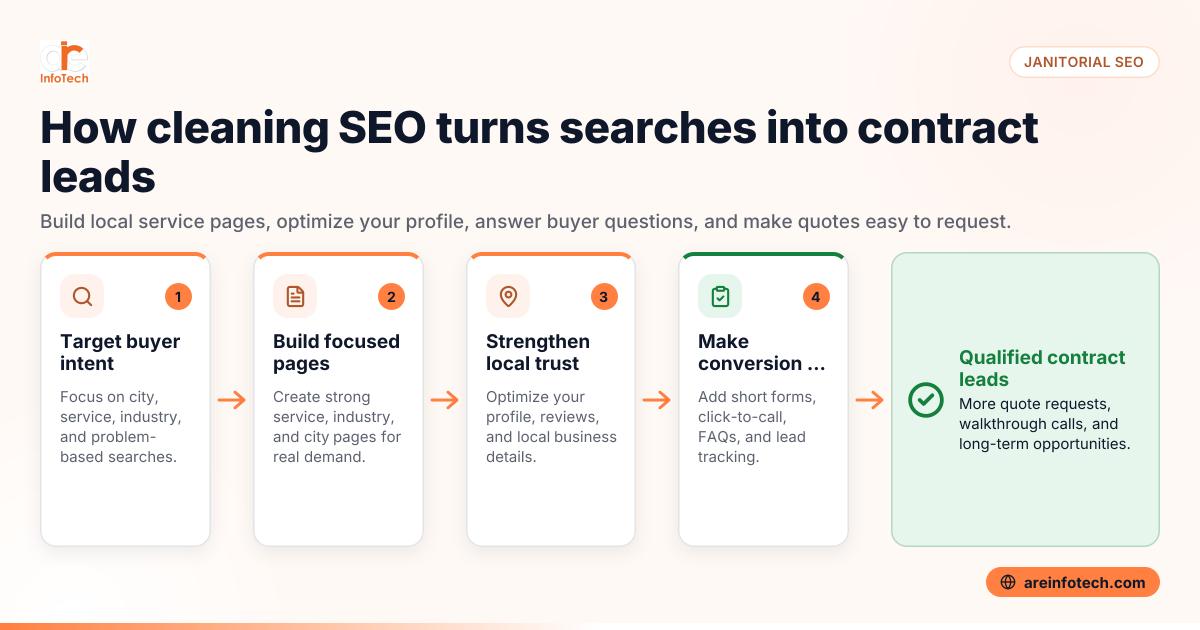
SEO for commercial cleaning companies in United States means making your website, Google Business Profile, and service pages easier to find when property managers, office admins, facility teams, and building owners search for janitorial help. Done well, it brings in more quote requests, walkthrough calls, and long-term contract leads from the cities and industries you actually want.
Commercial cleaning is a local, trust-based sale. Most buyers are not browsing for entertainment. They are searching because they need a vendor.
That buyer may be a property manager in Chicago looking for nightly janitorial service. It may be an operations manager in Houston who needs warehouse floor cleaning. It may be a medical office administrator in Detroit comparing vendors for recurring cleaning and disinfection.
In all of these cases, search intent is high. The buyer often wants one of three things:
SEO helps your company show up at that exact moment. It also helps your site build trust before the first call.
If your business depends on recurring contracts, SEO can be a strong channel because the value of one closed client is often much higher than the cost of generating the lead. One office park, clinic group, or industrial account can be worth far more than a one-time cleaning job.
It includes local SEO, on-page SEO, technical SEO, content, and conversion work. The goal is not just traffic. The goal is qualified contract leads.
A practical SEO program for a commercial cleaning company usually includes:
Many cleaning companies make the mistake of targeting broad phrases only. Terms like "cleaning services" are too wide. They do not reflect how B2B buyers search.
A better approach is to target specific combinations like:
These searches show stronger buying intent. They also let you build pages that match real demand.
The best keywords are usually local and specific. They describe the service, building type, and city the buyer cares about.
For example, a company serving downtown office towers and suburban medical buildings should not rely on one "services" page. It should create focused pages around each major revenue area.
Start with these groups:
Do not chase volume alone. Look for terms tied to profitable work.
A phrase with lower search volume may bring better leads if it matches your ideal client. A page for "medical office cleaning services in Houston" may outperform a broad city page if healthcare accounts are your focus.
Also review your current customer base. Ask:
Your keyword plan should follow these answers.
Most commercial cleaning websites are too thin. They often have a homepage, an about page, and a basic contact form. That setup rarely ranks well for multiple service areas and buyer types.
You need a structure that reflects how buyers search.
Create and improve these page categories:
These explain each main service in detail. Examples:
Each page should explain the scope, who it is for, what is included, and how to request a quote.
These help you win trust with buyers in specific facilities. Examples:
These pages work because they show you understand building-specific needs. Buyers want to know you can handle their environment.
If you serve multiple markets, build strong location pages. Do not copy and paste the same text across cities.
Each city page should include:
A weak location page will not help much. Search engines want useful local content. Buyers do too.
Instead of writing 150 nearly identical city pages, build fewer, stronger pages for the markets that matter most.
Claim and optimize your Google Business Profile, choose accurate categories, collect recent reviews, and keep your service pages aligned with your target cities and services. Google Maps rankings improve when your business information is complete, trusted, and locally relevant.
Your Google Business Profile often drives more leads than your website for local searches. That makes it a core part of SEO for commercial cleaning companies United States.
Focus on these basics first:
Reviews influence both rankings and conversions. A facility manager comparing vendors will often scan reviews before visiting your site.
Ask satisfied clients for reviews in a steady, compliant way. Do not pressure them. Do not offer fake incentives. Keep the process simple and consistent.
When possible, encourage reviews that mention the service type and location naturally. Those details can reinforce relevance.
Your company name, address, phone number, and website should be consistent across major listings. Inconsistent business details can weaken trust signals.
It should clearly name the service, the building types served, the areas covered, and the next step to get a quote. It should also reduce buyer risk with proof, FAQs, and simple contact options.
Rankings matter, but conversions matter more. A page that attracts the wrong traffic is not a win.
Every major service page should include:
Commercial cleaning buyers are busy. They want fast clarity.
They are asking questions like:
Answer these questions directly on the page. Avoid vague marketing language.
If true, you can mention experience with office buildings, medical offices, schools, or industrial spaces. If you have documented processes, explain them. If you can provide references during the sales process, say so carefully.
Do not invent certifications, guarantees, or outcomes.
A company serving one metro area needs a different SEO plan than a regional operator covering several states. The larger your footprint, the more important page structure becomes.
If you mainly serve one city and nearby suburbs, focus on depth. Build strong pages for core services, industries, and neighborhoods within that market.
For example, a Chicago-area company might build:
If you serve multiple states or large metro areas, organize the site carefully. Use parent pages and child pages where needed.
For example:
This structure helps search engines understand your coverage and helps buyers find the right page faster.
Technical SEO is often less visible, but it supports everything else. If your site is hard to crawl, slow to load, or confusing to navigate, rankings can suffer.
Check these items:
A large share of local B2B searches happen on phones. If your number is hard to tap or your form is too long, leads will drop.
Keep quote forms short. Ask only what your sales team needs to qualify the inquiry.
Content helps you rank for early-stage searches and build trust with serious buyers. It also supports sales conversations after the lead comes in.
You do not need a huge publishing schedule. You need useful content tied to real buyer questions.
Write content around topics such as:
This type of content can attract buyers earlier in the process. It also gives your team assets to send during follow-up.
If you want examples of practical SEO writing structures, you can review the ARE InfoTech blog.
Industry pages and educational articles can reinforce your expertise. They also create internal linking opportunities to your quote pages.
For companies in specialized B2B niches, this same principle shows up in articles like SEO for ERP Software Companies in United States: How to Generate More Demo Requests From Manufacturing Buyers, where pages must align with specific buyer intent.
Many companies track rankings and traffic but ignore lead quality. That is a mistake.
For a commercial cleaning company, the best SEO metrics are tied to pipeline.
Monitor:
If possible, tag leads in your CRM or tracking sheet by source. Then review which pages and keywords lead to real opportunities.
For example, you may learn that warehouse cleaning pages generate fewer leads but higher contract values than general office cleaning pages. That insight should guide future SEO work.
ai seo can speed up keyword grouping, content outlines, and optimization checks, but it should not replace human judgment. Local accuracy, service knowledge, and clear conversion writing still decide whether traffic turns into real janitorial leads.
AI can be useful for workflow support. It can help your team find topic gaps, organize service clusters, and draft first versions of content. But it can also create bland, repetitive pages that do not rank or convert.
If you use AI in your process, review every page for:
This matters because commercial cleaning SEO is local and practical. Buyers can spot fluff quickly.
Several mistakes show up again and again.
Broad terms often bring weak traffic. Focus on local and service-specific searches.
Separate pages usually perform better because they match intent more closely.
Thin, repeated pages create weak signals and poor user experience.
Map visibility can drive strong local leads. It should not be treated as optional.
If buyers cannot call or request a quote easily, rankings will not help much.
Traffic without qualified leads is not the goal.
If you need a simple starting point, use this sequence.
Google Reviews


