
Oct 12, 2026
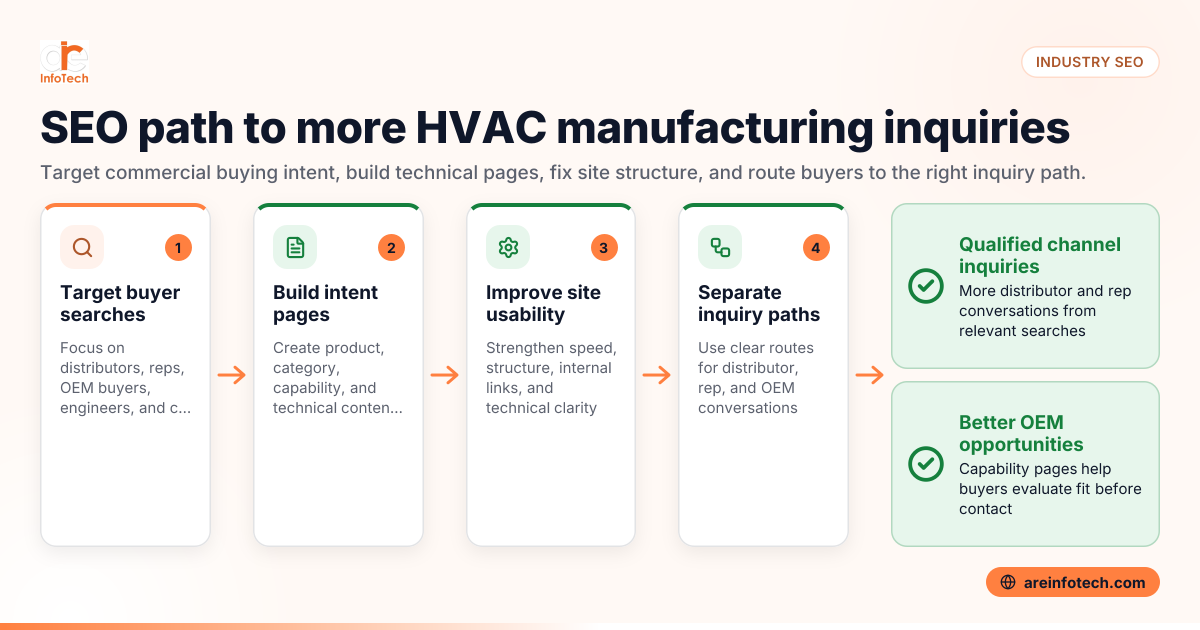
SEO for HVAC manufacturers in United States means making your website easier to find when distributors, manufacturer reps, OEM buyers, engineers, and contractors search for products, specs, and supplier information. Done well, it brings in qualified inquiries from buyers who already need your equipment, components, or private-label manufacturing capacity.
HVAC buyers in United States do not search like retail consumers. They search with job-focused language. They look for product categories, tonnage ranges, airflow specs, refrigerant compatibility, efficiency details, installation requirements, controls, certifications, and manufacturing capabilities.
That matters because your website is often the first filter. Before a distributor fills out a form. Before a rep requests line card information. Before an OEM sourcing manager schedules a call. They check whether your site looks credible, technically sound, and easy to work with.
Many HVAC manufacturers still rely heavily on trade shows, existing channel relationships, and outbound sales. Those channels still matter. But buyers now do research long before they contact a supplier. If your site does not rank for the right searches, you lose visibility to manufacturers, private-label suppliers, and component brands that publish better technical content.
SEO for HVAC manufacturers in United States is not about chasing random traffic. It is about showing up for searches that signal commercial intent, such as:
These searches may have lower volume than broad terms. But they often carry higher buying value.
Your SEO strategy should align with the actual people who influence buying. In HVAC manufacturing, that usually means several audiences, not one.
Distributors want product availability, line depth, territory support, documentation, warranty information, and sales tools. They may search by product family, application, region, or manufacturer type. They also want to know whether you support channel growth.
A distributor in Chicago may search for packaged units, ventilation equipment, replacement parts, or commercial accessories based on market demand. If your site lacks clear product pages and distributor information, they may move on quickly.
Independent reps want to know whether your line is sellable. They look for margin opportunity, territory availability, training, marketing support, and technical differentiation. They also want confidence that your website helps them sell.
This means your SEO should not stop at lead generation. It should also support rep enablement with application pages, downloadable sell sheets, comparison content, and product selectors.
OEM sourcing teams search in a very specific way. They often care about tolerances, manufacturing process, capacity, lead times, engineering support, compliance, and custom options. These buyers may not search for your brand. They search for capabilities.
If you make coils, housings, dampers, controls assemblies, cabinets, heat exchangers, or fabricated HVAC components, your SEO should include capability pages. Those pages should explain what you build, for which systems, and for what production needs.
Engineers influence product selection early in the process. If your technical content ranks, you can get considered before the sales conversation starts. This is especially useful for commercial, industrial, and specialty HVAC products.
A good HVAC manufacturing SEO strategy combines search visibility, technical trust, and buyer usability. It should help a visitor understand what you make, where it fits, and how to contact the right team.
Most HVAC manufacturer sites have product pages. Fewer have pages built around the way buyers search.
A strong page should include:
For example, a page called “Commercial Air Handlers” is better than a vague title like “Products.” A page for “OEM Evaporator Coils for Packaged Systems” may attract more qualified traffic than a broad capabilities page alone.
If you want OEM inquiries, you need pages that speak directly to OEM buyers. Many manufacturers bury this under an “About” page or a generic contact form.
Create dedicated pages for:
These pages should explain what you can produce and for whom. They should also make the next step clear.
Technical buyers need more than polished marketing copy. They want answers. That is where SEO content creates real value.
Examples include:
Useful content builds trust and supports both organic rankings and ai seo visibility. AI-driven search tools tend to quote pages that answer specific questions clearly.
Create pages around product lines, territories, support, and channel value. Then rank for searches distributors use when they evaluate a line, not just end-user product terms.
After that, build out the details. Distributors often compare suppliers fast. They need proof that your line is marketable and supportable.
That means your site should include:
Do not force every visitor through one generic “Contact Us” page. A distributor inquiry should route differently from an OEM quote request.
It should explain what you manufacture, your production capabilities, quality process, engineering support, and how an OEM buyer can start the conversation in one step.
Then make it practical. An OEM page should include the exact details a sourcing or engineering contact needs to see.
Add sections such as:
This reduces friction. It also improves lead quality because buyers know what to submit.
Keyword research for HVAC manufacturers is different from local service SEO. You are not just targeting “near me” terms. You are targeting product, application, and capability intent.
These are direct searches for what you make.
Examples:
These show how the product is used.
Examples:
These attract OEM and private-label buyers.
Examples:
These can attract technical users earlier in research.
Examples:
If your site has strong document SEO, spec sheets and manuals can rank on their own. That often brings highly relevant traffic.
A confusing site structure hurts both SEO and conversions. HVAC manufacturing sites often grow over time and end up hard to navigate. Product categories overlap. Files are buried. Important pages sit three or four clicks deep.
A better structure usually includes:
A sourcing manager from Houston should be able to land on your site and quickly find OEM capabilities. A rep should be able to find product line information without digging through technical PDFs.
Internal links help both search engines and users. Link related product pages together. Link capabilities pages to product categories. Link educational content to inquiry pages.
If you publish broader industrial SEO content, resources on the ARE InfoTech blog can help frame how search strategy fits B2B lead generation. For software-related industrial buying journeys, SEO for ERP Software Companies in United States: How to Generate More Demo Requests From Manufacturing Buyers also shows how technical B2B buyers search before they contact sales.
Content should support real sales conversations. That means fewer generic trend posts and more buyer-useful pages.
This content also helps with AI search. Clear, scannable explanations improve your chances of being cited in answer engines.
A lot of industrial sites lose rankings because of basic technical problems, not weak products.
Your buyers often visit from desktop at work. But they still expect a fast, clean site. If spec sheets do not load, navigation is clumsy, or forms fail, trust drops fast.
Also, search engines need help understanding technical content. Use clean headings, descriptive URLs, and structured page layouts. Do not hide essential information inside images or scanned PDFs.
Structured data can help search engines better understand your content. For HVAC manufacturers, that may include organization details, product information, and FAQ content where appropriate.
You do not need to overdo it. The priority is still strong page content and clear site architecture.
Track qualified inquiries, not just rankings. The best SEO result is more distributor, rep, and OEM conversations from the right accounts.
Here are the metrics that matter most:
If possible, label forms by inquiry type. Ask whether the lead is a distributor, rep, OEM, engineer, or contractor. Route each path to the right team.
Then review which pages influenced those leads. This helps you invest in pages that move revenue, not just traffic.
If your team uses QuickBooks and Stripe on the finance side, your sales and marketing stack may still be fragmented. That is normal. Even without a perfect CRM setup, you can still track source, page path, and inquiry type well enough to see what SEO is producing.
If buyers already know your brand, they can find you. SEO growth usually comes from non-branded searches.
A product name and one image are not enough. Buyers need specs, applications, documents, and next steps.
If custom manufacturing is a revenue driver, it deserves dedicated search-targeted pages.
Different buyers have different needs. Segment inquiry paths to improve conversion and sales follow-up.
SEO is ongoing. Products change. Search behavior changes. Competitors improve. Your content and technical setup should improve too.
If you want a realistic starting point, focus on the highest-impact work first.
This approach is simple, but it works because it aligns SEO with actual buyer behavior.
If your internal team cannot consistently improve technical SEO, publish useful content, and track lead quality, outside help can speed progress. This is especially true when your site serves several audiences and product lines.
A specialist can help with keyword mapping, site structure, technical fixes, content planning, and conversion improvements. If you need that support, ARE InfoTech can help you build an SEO program around real B2B buying intent instead of vanity traffic.
Google Reviews


