
Oct 12, 2026
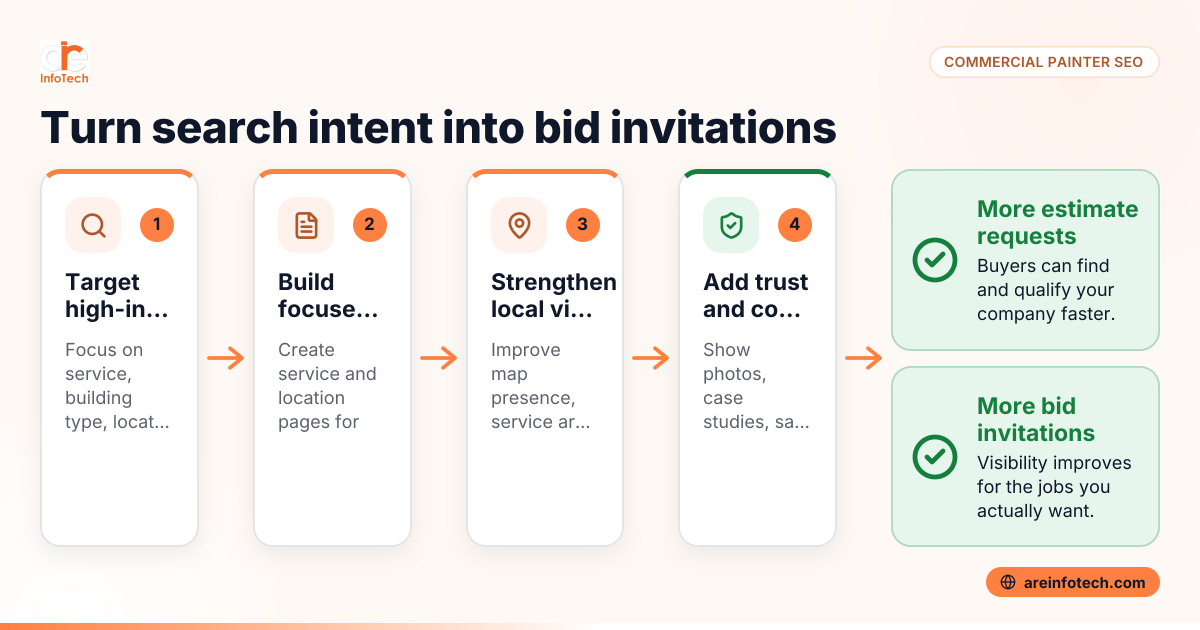
Commercial painting buyers in the United States search online before they invite contractors to bid. Strong SEO helps your company appear when property managers, general contractors, and facility teams look for painters in their area. If your site ranks for the right local and service terms, you can win more estimate requests and more bid invitations.
Commercial painting is a high-consideration purchase. Buyers rarely hire the first contractor they see. They compare experience, service area, project type, safety standards, and response speed.
That makes SEO valuable. It puts your business in front of buyers at the moment they are looking for help. These buyers may be searching for:
These are not casual searches. They often come from people building a bid list. If your company is missing from search results, you may never get invited to quote.
SEO for commercial painters United States is not just about rankings. It is about showing up for the right jobs. A painting contractor that wants office repaints, warehouse work, and multi-site maintenance needs different pages and keywords than one that focuses on schools or healthcare buildings.
SEO for commercial painters in United States means improving your website, Google Business Profile, local signals, and content so buyers can find you when they search for painting services in your market.
At a practical level, it includes keyword research, service pages, local SEO, technical fixes, content, reviews, and conversion improvements. It should connect directly to sales goals, not vanity traffic.
A good campaign usually includes these areas:
Your online audience is broader than many painting companies think. It is not just one type of buyer. Different decision-makers search in different ways.
They often need repainting for office buildings, apartment common areas, retail centers, and tenant turnover work. They value speed, reliability, and clear scheduling.
They search for subcontractors they can trust on larger projects. They care about scope fit, jobsite professionalism, insurance, and schedule discipline.
They look for ongoing maintenance partners and low-disruption painting services. These buyers often need interior work during off-hours.
They may search directly for exterior repainting, waterproof coatings, or capital improvement work. Their focus is often on long-term value.
Larger organizations may search by region, service category, or building type. They often want structured estimate requests and proof of capability.
Your SEO strategy should speak to these different buyers. A page about “commercial painting services” is too broad by itself.
The best keywords are the ones tied to real buying intent. Search volume matters, but job value matters more.
Start by organizing terms into groups.
Do not chase every search. Build pages around the work you want most. If your best jobs come from warehouses and industrial spaces, create strong pages for those terms. If your margins are better on office repaints, lead with that.
This focused approach also supports ai seo workflows. AI search tools often summarize the clearest and most specific pages first. A page that precisely matches the buyer’s need has a better chance of being surfaced.
You get found by aligning your site with search intent, local relevance, and buyer trust. That means optimized service pages, a strong Google Business Profile, clear location signals, and proof you can handle commercial jobs.
From there, consistency matters. Keep pages updated, publish useful content, earn reviews, and make it easy for search engines to understand your services and service areas.
Many commercial painters have one generic services page. That is a missed opportunity. You need separate pages for the services and project types buyers actually search for.
Examples include:
Each page should explain:
If you serve multiple metro areas, create location pages only where you can support them honestly. Do not mass-produce thin city pages. Instead, write useful pages for real markets, such as Chicago, Houston, or Detroit, with content about project types, service coverage, and response expectations.
Your Google Business Profile is critical for local SEO. Make sure it includes:
Reviews also matter. Ask satisfied commercial clients to mention the project type and location when appropriate.
Your website should quickly prove that you handle commercial work, serve the buyer’s area, and make estimate requests simple. Clear service pages, project photos, trust signals, and strong calls to action turn traffic into bid invitations.
Buyers also want confidence. Show safety practices, insurance readiness, scheduling flexibility, and examples of similar jobs so visitors can qualify you fast.
State that you focus on commercial painting. Do not make buyers guess whether you do residential work, commercial work, or both.
Create pages around the specific services and building types you want. This helps rankings and conversions.
Show before-and-after photos where possible. Include captions that describe scope, building type, and city.
You do not need long stories. A short project summary can help a lot. Include the client type, challenge, scope, and outcome.
Examples include:
Place calls to action throughout the site:
Use short forms. Ask only for the information needed to start the conversation.
Commercial painting SEO is still local. Even larger contractors usually win work within defined regions. Search engines need clear signals about where you work.
Here is a practical process:
A buyer looking for a contractor often clicks one of the top local listings first. If your Google Business Profile is weak, incomplete, or inactive, you may lose those clicks even if your website is solid.
Content should answer buyer questions before they call. It should also help you rank for informational searches that lead into estimate requests later.
Good topics include:
This kind of content builds trust. It also creates entry points for buyers earlier in the decision process. If you want to see how industry-specific SEO content is structured, browse the ARE InfoTech blog.
Avoid generic blog posts that could apply to any contractor. Focus on questions your sales team hears every week. If clients ask about night work, scheduling around tenants, or coating durability, create content around those topics.
A strong website still underperforms if technical SEO is weak. Search engines need to crawl your pages easily. Buyers need a fast, smooth experience on mobile.
Large image galleries often slow painting websites. Compress images and use sensible file sizes.
Many buyers first visit your site from a phone. Your contact forms and phone links must work cleanly.
Each page should target a distinct keyword and location theme.
Link related service pages together. For example, interior painting pages can link to office painting and warehouse painting pages.
Make sure important pages can be indexed. Remove or fix broken pages and duplicate content.
Install analytics and form tracking. If you use call tracking, set it up carefully so local SEO signals stay clean.
Measure SEO by qualified leads, bid invitations, and estimate requests, not just traffic. The right metrics show whether search visibility is producing real pipeline.
Useful indicators include rankings for target terms, Google Business Profile activity, phone calls, form submissions, and which pages lead to estimate requests.
Track these every month:
If possible, mark leads by type inside your CRM or sales process. Separate low-fit inquiries from real opportunities. The goal is not just more leads. The goal is more profitable commercial painting jobs.
If your company serves adjacent industries, you may also find ideas in related posts such as SEO for Commercial Cleaning Companies in United States: How to Get More Janitorial Contract Leads.
Even good contractors can waste time on the wrong SEO tactics. These mistakes usually slow growth.
“Painter” or “painting company” is too vague. Commercial buyers search with more specific terms.
A single services page cannot rank well for every building type and project type.
Buyers want to know you can handle occupied spaces, larger crews, access equipment, and schedule constraints.
If your site says only “contact us,” you may lose buyers who want to request a bid quickly.
Low-value location pages rarely perform well and can hurt trust.
Search behavior is changing. Buyers increasingly use AI-assisted tools to shortlist vendors. Clear service pages, strong FAQs, and structured answers improve your visibility in both classic search and AI search experiences.
You do not need to do everything at once. Start with the pages and fixes most likely to produce leads.
This kind of plan works best when tied to clear revenue goals. If you need outside help, ARE InfoTech can support strategy and execution, but the key is staying focused on lead quality.
If your commercial painting company is not getting enough bid invitations or estimate requests, an SEO audit is the best place to start. A good audit shows which pages can rank, where leads are leaking, and what to fix first. It should cover keywords, local SEO, technical issues, content gaps, and conversion paths.
SEO usually takes time because rankings improve as pages are optimized and trust builds. You may see early gains in a few months, but stronger lead flow often comes from steady work over a longer period.
Google Reviews


