
Oct 11, 2026
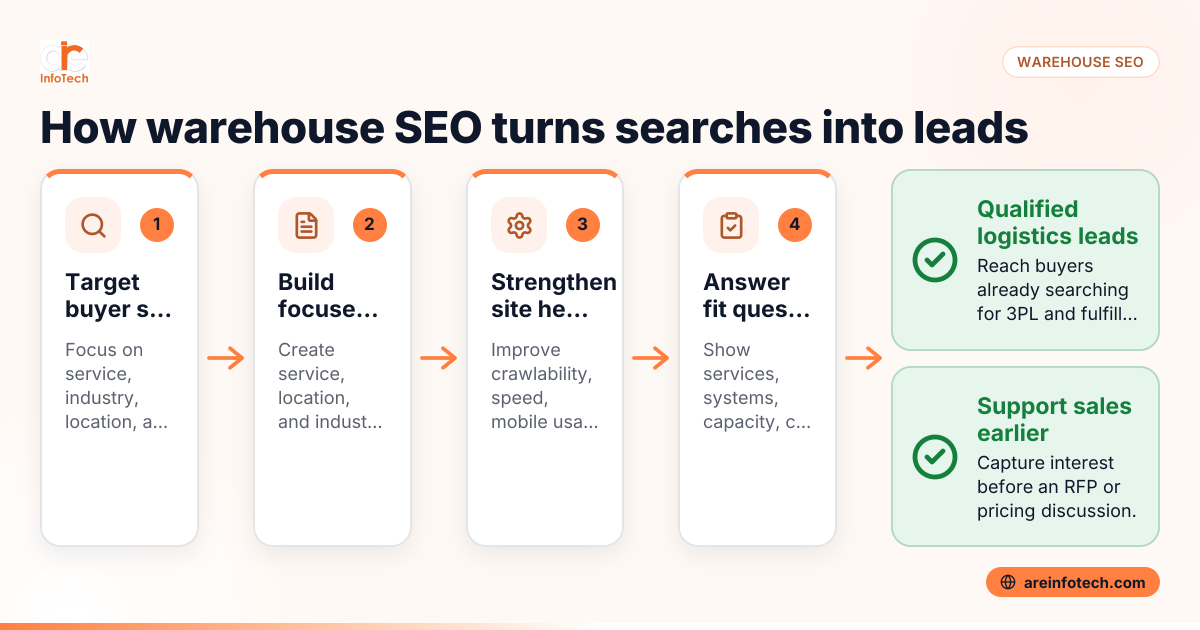
SEO for warehouse and fulfillment companies in United States means making your company easier to find when shippers search for 3PL, warehousing, pick and pack, eCommerce fulfillment, and distribution support. Done well, it brings in more qualified leads from businesses already looking for storage, shipping, kitting, or multi-location logistics help.
Most warehouse and fulfillment buyers do not start with a cold call. They start with a search. They look for terms like “3PL warehouse Chicago,” “eCommerce fulfillment company Houston,” or “temperature controlled warehouse near me.”
That search behavior matters because it signals buying intent. A company searching for a 3PL is often solving a real problem. They may be outgrowing in-house fulfillment. They may need lower shipping costs. They may need better inventory visibility. They may need a new partner after service failures.
SEO helps your business show up at that exact moment.
For warehouse and fulfillment companies, SEO is not just about traffic. It is about visibility for the right services in the right markets. A national 3PL may want leads from multiple states. A regional warehouse operator may only want demand from the Midwest or Gulf Coast. A fulfillment provider focused on Shopify or Amazon sellers may need a different strategy than a company serving automotive suppliers in Detroit.
Good SEO aligns your site with how buyers search. It also makes your value clear fast. Buyers want to know:
If your website does not answer those questions, your rankings and conversion rates both suffer.
It includes keyword targeting, service pages, location pages, technical fixes, Google Business Profile work, content creation, and conversion improvements. The goal is simple: rank for buying-intent searches and turn visits into calls, quote requests, and RFP conversations.
In practice, SEO for this industry must connect marketing language with operational reality. You are not selling a simple consumer service. You are selling an operational partnership. That means your website needs to speak to decision-makers in operations, supply chain, eCommerce, procurement, and finance.
A practical SEO program for a warehouse or fulfillment company usually includes these areas:
This is also where ai seo becomes useful. It can help teams find content gaps, cluster keywords, and improve page structure faster. It should support strategy, not replace it.
The best keywords usually combine a service, a location, and a business need. Terms with vague informational intent may bring traffic, but they often do not bring serious buyers.
For example, these search patterns often matter more than broad vanity terms:
A term with lower search volume can still be more valuable if it matches your ideal customer. A search like “3PL for subscription box fulfillment” may bring fewer visits than “warehouse services,” but it can be much closer to a buying decision.
This is why segmentation matters. Start by grouping keywords into these buckets:
Not every warehouse company should target every bucket. The right mix depends on your service model and margins.
Use separate pages for each core service, major location, and priority industry. Make each page specific enough to rank and useful enough to convert.
Your service pages should map directly to what buyers search for. A single “services” page is rarely enough. Create standalone pages where needed for:
Each page should explain:
If you serve multiple markets, create location pages with real local relevance. Do not publish thin pages that only swap city names.
A good location page might include:
For example, a page for Chicago might focus on Midwest distribution efficiency. A Houston page might highlight Gulf Coast logistics access. A Detroit page might speak more to manufacturing and industrial distribution.
Industry pages can work well when your operations truly fit those needs. Examples include:
These pages help buyers quickly see whether you understand their shipping patterns, compliance needs, and order profiles.
Create content that answers real pre-sales questions. Focus on operations, service fit, onboarding, and cost drivers instead of generic blogging.
A warehouse or fulfillment buyer is evaluating risk. They want confidence that your company can handle their volume, systems, and service standards. Useful content builds that confidence.
Strong topics include:
This kind of content helps in search and sales. It can also support account executives during follow-up.
If your company serves a niche audience, create content for that audience. A fulfillment company serving manufacturers will need different content than one serving direct-to-consumer brands. You can see similar industry-specific SEO thinking across the ARE InfoTech blog, including pages like SEO for ERP Software Companies in United States: How to Generate More Demo Requests From Manufacturing Buyers.
Local SEO helps your company appear in map results and location-based searches when nearby or regional buyers look for warehousing and fulfillment support.
Local visibility matters even for B2B logistics. A buyer may prefer a provider near a port, parcel hub, customer cluster, or manufacturing corridor. They may search by city or state even if service is regional.
Start with your Google Business Profile. Make sure your name, address, phone number, category, hours, and service details are accurate. Add photos of your facility, not stock images.
Then strengthen local relevance by:
Local SEO is especially useful for companies with one or more facilities and a defined service footprint.
Slow pages, weak internal linking, poor mobile usability, and duplicate location content are common problems. If search engines cannot crawl and understand your site well, rankings suffer.
Technical SEO often gets ignored in B2B logistics because teams focus on service messaging first. But technical issues can hold back strong content.
Check these basics:
For larger operators, site architecture matters even more. If you have dozens of locations or service combinations, your navigation and internal links should help search engines understand page priority.
Also consider buyer expectations. Many larger prospects expect signs of operational maturity. Clear privacy practices, stable forms, and a secure site support trust. If you mention technical capabilities or integrations, be accurate. Do not imply certifications or controls, such as SOC 2 alignment, unless your company can support those claims.
Make it easy for visitors to identify fit, ask questions, and request next steps. Good SEO brings traffic. Good conversion design turns that traffic into pipeline.
A buyer visiting a warehouse website is not always ready for a full RFP. Some want a call. Some want service coverage details. Some want integration confirmation.
Use multiple calls to action, such as:
Your forms should be simple but useful. Ask for name, company, email, phone, monthly order volume, service need, and location. Email and phone are still the main business channels for this type of sale.
Trust signals help conversions. Useful examples include:
Avoid inflated claims. Do not say you are the best. Do not promise turnaround times you cannot guarantee. Do not publish made-up testimonials or statistics.
If you want steady growth, treat SEO as a structured program, not a one-time project.
List your best customers by order profile, industry, geography, and margin. Separate ideal eCommerce clients from wholesale, retail, or industrial accounts.
Build keyword groups around each core service. Then connect them to target locations and industries.
Create or improve service pages, location pages, and industry pages. Remove thin or overlapping content.
Audit crawlability, speed, mobile experience, forms, and internal links. Fix the issues blocking growth first.
Publish articles that address selection, onboarding, pricing factors, service comparisons, and logistics pain points.
Optimize your Google Business Profile and local landing pages. Support each facility with accurate business data.
Track calls, form fills, quote requests, and sales-qualified opportunities. Rankings alone are not enough.
Review which pages bring real leads. Expand what works. Cut what does not. This is where data, search intent, and ai seo workflows can help teams move faster.
If your internal team lacks time, an experienced partner can help prioritize the work. ARE InfoTech can support businesses that want a practical SEO roadmap tied to lead generation, not vanity metrics.
Many logistics websites underperform because they look polished but say very little. Others publish content that targets broad traffic but not real buyers.
The fix is not more words alone. The fix is clearer strategy, stronger pages, and better alignment with buyer needs.
If your warehouse or fulfillment company is not getting enough qualified 3PL and logistics leads, start with an SEO audit. Review your current rankings, service pages, location coverage, technical issues, and conversion paths.
A useful audit should answer three questions:
For businesses in competitive markets, the fastest gains often come from improving existing service pages, building stronger local pages, and tightening conversion paths. If you want a practical outside review, ARE InfoTech can help assess your site and identify the next SEO priorities.
Most companies should expect SEO to take several months before meaningful lead growth appears. The timeline depends on your market, website quality, competition, and how much content and technical work is needed.
Google Reviews


