
Oct 12, 2026
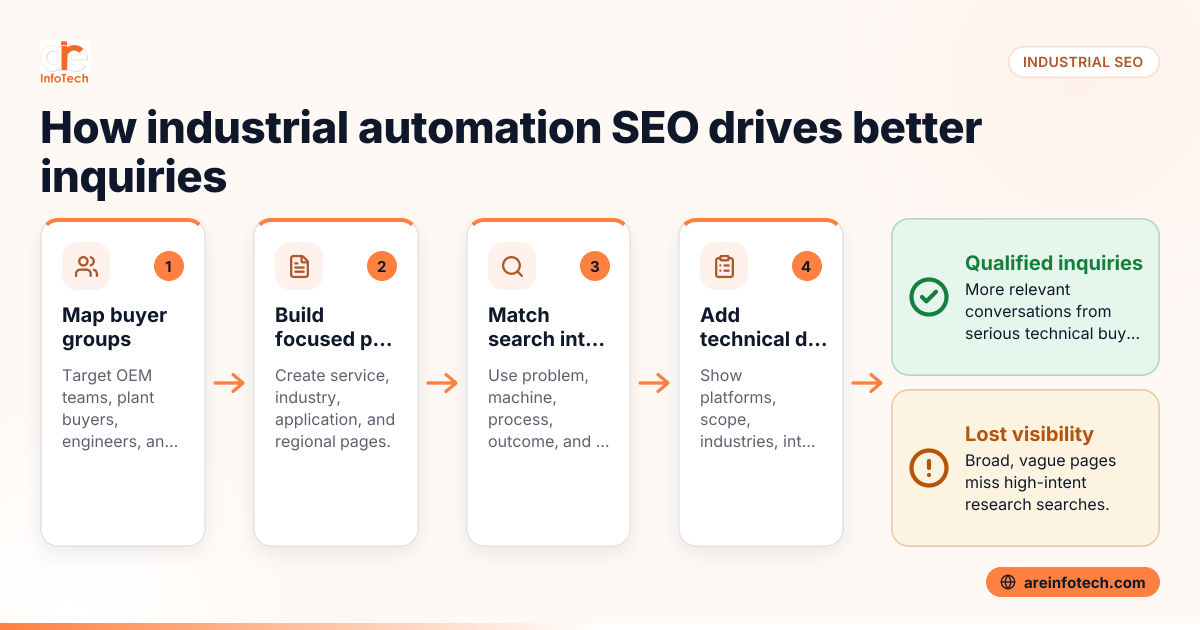
Industrial automation buyers in the United States do not search like consumers. They search by problem, machine type, plant need, and buying context. SEO for industrial automation companies in United States means building a website that shows up for those high-intent searches and turns engineers, OEM teams, and plant buyers into qualified inquiries.
Done well, SEO helps you attract buyers before they send an RFQ list to competitors. It also helps your company appear credible when a prospect in Chicago, Houston, or Detroit checks your site after getting your name from a rep, distributor, or referral.
Industrial automation sales cycles are rarely simple. A buyer may start with a maintenance problem, a controls upgrade, a robotics project, or a line-efficiency issue. They might search for PLC programming help, machine vision integration, conveyor automation, SCADA upgrades, or turnkey control panel design.
That means your website has to do more than look modern. It has to match the way real buyers search.
In the United States, many automation companies still depend heavily on referrals, rep networks, trade shows, and outbound sales. Those channels can work well. But buyers still research online before they reply, book a call, or request a quote. If your site does not explain what you do in a clear and searchable way, you lose visibility during that research phase.
SEO helps in three practical ways:
For example, a plant manager may not search for your brand name. They may search for "PLC retrofit for packaging line," "robot palletizing integrator in Texas," or "UL 508A control panel builder." If you do not have pages built around those needs, search engines have little reason to rank your site.
Your SEO strategy should start with buyer groups, not just keywords.
OEM teams often need automation partners for machine controls, HMI development, safety integration, motion control, sensors, or panel design. They care about repeatability, documentation, deadlines, and long-term support.
Plant managers, engineering managers, and maintenance leaders usually care about uptime, throughput, labor savings, safety, and retrofit practicality. They want fast answers and low implementation risk.
Controls engineers and project engineers may be the first people researching suppliers. They look for technical depth. They want to see capabilities, platforms, industries served, and examples of similar work.
These buyers may join later. They care about responsiveness, scope clarity, compliance expectations, and confidence that your company can deliver.
Your SEO content should speak to all four groups without becoming vague.
Start with service pages, industry pages, and application pages. Each page should focus on one clear buyer need and one clear search intent.
The first pages often include:
A short answer: build pages around what buyers actually purchase and how they describe the job.
Under each page, include practical detail. Mention supported platforms, project scope, common problems solved, industries served, and what a buyer should expect during discovery and implementation.
Then add proof. That can include project types, equipment categories, process familiarity, and integration experience with common ERP or plant systems where relevant. Avoid thin pages that only say you offer "custom solutions."
A prospect may search for broad terms, but many industrial buyers use very specific language. Your page titles and copy should reflect that.
For instance, a page titled "Automation Solutions" is too broad. A page titled "PLC Programming and Controls Integration for Manufacturing Plants in United States" is clearer. It tells search engines and buyers what the page is about.
They search by problem, equipment, process, and location. Broad terms bring weak traffic. Specific terms bring better inquiries.
Plant buyers often search in stages. Early searches focus on symptoms or project type. Later searches focus on supplier fit. A maintenance lead might first search "legacy PLC upgrade." After narrowing vendors, that same person may search your brand, certifications, or service area.
Here are common search patterns:
This is why keyword research must go beyond search volume. Good SEO for industrial automation companies in United States focuses on commercial intent and project relevance.
Create content clusters around actual jobs your team handles. For example:
These topics help you rank for long-tail searches and also help buyers self-qualify.
Your keyword strategy should map terms to page types.
These target direct service intent:
These target relevance by vertical:
These target early research intent:
These matter when your team sells or services defined areas. If you work heavily in Illinois, Texas, or Michigan, build useful regional pages tied to actual service capacity.
Do not create dozens of near-duplicate city pages with no substance. That tends to perform poorly and can weaken trust.
Ai seo means structuring your pages so search engines and AI assistants can understand your expertise, services, and buyer answers quickly.
That starts with concise answers near the top of key pages. It also means using plain language, clear headings, complete service descriptions, and strong internal linking. Technical buyers still want detail, but AI systems quote pages that are easy to parse and clearly written.
For industrial automation firms, this matters because many searches are technical questions. An AI assistant may summarize who handles PLC retrofits, robotics integration, or machine vision projects in a certain market. If your content is vague, you are less likely to be cited or surfaced.
AI search does not replace classic SEO. It rewards many of the same fundamentals:
This is one reason to avoid marketing-heavy fluff. Buyers and AI systems both prefer specificity.
On-page SEO is where strategy becomes visible.
Each important page should have one main topic. Your title tag, H1, and main headings should align with that topic. If a page is about PLC programming, keep it focused there.
A buyer should know within seconds:
This also supports AI-friendly quoting behavior.
Include details such as:
Industrial buyers do not always want a hard sell. They often prefer a low-friction next step, such as:
That is usually stronger than a generic "Contact us."
Even great content struggles if the site is hard to crawl or slow to use.
Many industrial sites are image-heavy and PDF-heavy. That can create SEO problems. Search engines often cannot interpret technical PDFs as well as HTML pages. PDFs can still be useful, but your primary service and industry content should live on indexable web pages.
If your capabilities, industries, and engineering expertise only exist inside a brochure download, you are limiting organic visibility. Put the essentials on the page first. Then offer a downloadable asset for buyers who want more detail.
Even if you sell nationally, geography still matters in industrial buying. Some prospects want a partner who can visit the plant, handle commissioning, or support nearby facilities.
If you serve defined regions, make sure your Google Business Profile and key site pages reflect that. Include your real office location, service areas, and clear descriptions of what you do.
Local SEO is especially useful for firms that depend on plant visits, startup support, field service, or regional reputation. Buyers may search by metro area when they need faster access or local accountability.
Cities like Chicago, Houston, and Detroit have dense manufacturing activity. If your company serves those markets, build useful regional content around actual project fit, not generic city text.
Industrial content should help a buyer make a decision.
For example, a good article might explain how to scope a PLC modernization project, what information a plant should gather before talking to an integrator, and when a phased retrofit makes sense.
That kind of content attracts serious buyers. It also supports sales conversations after the first visit.
If you want examples of how industry-specific SEO can be structured, browse the ARE InfoTech blog. The same practical approach applies across technical B2B markets, whether the niche is manufacturing support, contractors, or logistics.
If you publish case studies, focus on the challenge, system environment, scope, and business outcome. Keep confidential details private, but add enough substance to show credibility.
Good case studies can rank for niche searches and help buyers see themselves in the project.
Traffic alone is not enough. Your site has to convert technical interest into inquiries.
Use forms that ask useful qualifying questions, such as:
Do not make forms too long. But give your sales team enough context to prioritize serious opportunities.
Industrial buyers often return several times before contacting you. Help them keep moving by offering:
Phone and email are still major channels in United States B2B buying. Make both visible on your site.
Most companies see meaningful SEO progress over months, not weeks. Faster gains usually come from fixing major site issues and improving existing service pages.
Competitive markets and technical niches take time. Results depend on your starting point, content depth, competition, and how well your site turns visits into leads. The goal is not just more traffic. The goal is more qualified OEM and plant buyer inquiries.
Several factors matter:
A weak site with thin content may need foundational work first. A stronger site can often grow faster by expanding into overlooked long-tail topics.
These mistakes are common and expensive.
Words like "innovative solutions" and "custom excellence" say very little. Buyers want to know what you actually implement.
Broad traffic may look good in reports, but niche, high-intent searches usually produce better leads.
If you work across packaging, automotive, food processing, or warehousing, show that clearly. Buyers want relevant experience.
Some companies oversimplify to sound accessible. That can backfire. Technical buyers need enough detail to trust you.
A brochure-style site may look polished but still fail at organic search. SEO needs indexable pages built around real search intent.
If your industrial automation company wants more OEM and plant buyer inquiries, start with an SEO audit. Review your current rankings, service pages, technical issues, conversion paths, and content gaps.
Google Reviews


