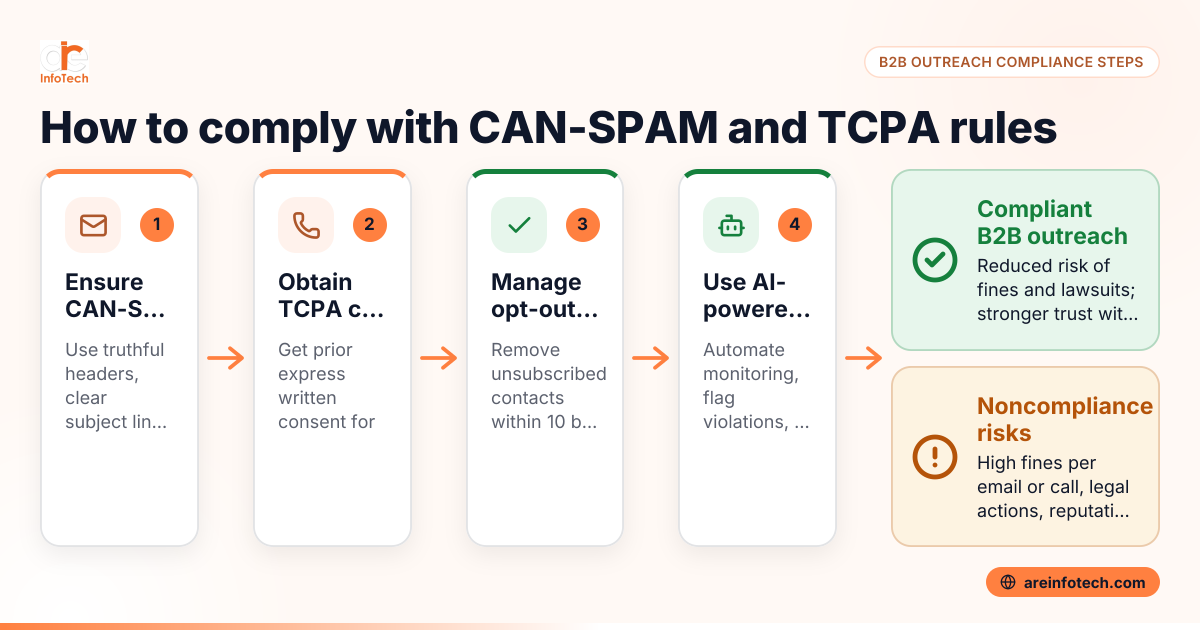
Complying with CAN-SPAM and TCPA regulations is essential for B2B businesses in the United States conducting email and phone outreach. These laws set clear rules on consent, message content, opt-out processes, and call practices to protect recipients from unwanted marketing. Following CAN-SPAM and TCPA guidelines not only helps you avoid costly fines but also builds trust and credibility in your business communications.
Key takeaways
- CAN-SPAM applies to commercial email messages, requiring truthful headers, clear subject lines, and conspicuous opt-out options.
- TCPA regulates telemarketing calls, texts, and autodialer use, generally requiring prior express consent for B2B calls involving automated technology.
- Obtaining and documenting written consent, providing clear disclosures, and promptly honoring opt-out requests are critical to compliance.
- Violations can result in steep fines — up to $46,517 per email and $500 to $1,500 per call or text — as well as legal actions and reputation damage.
- AI-powered compliance tools help automate monitoring, flag potential violations, and maintain accurate records.
- Establishing robust policies and training teams ensure your B2B outreach remains both effective and compliant.
What is the CAN-SPAM Act and how does it affect B2B email outreach?
The CAN-SPAM Act, enacted in 2003, is a federal law designed to regulate commercial email and reduce spam in the United States. It applies broadly, including to business-to-business (B2B) email marketing. Its primary goal is to ensure transparency, prevent deceptive practices, and offer recipients straightforward options to stop receiving unwanted marketing emails.
Overview of CAN-SPAM requirements for B2B emails
Under CAN-SPAM, any email that advertises or promotes a commercial product or service—even in B2B communications—must comply with the following rules:
- Accurate header information: The “From,” “To,” “Reply-To,” routing information, and domain name must identify your business truthfully to avoid misleading receivers.
- Clear subject lines: The subject line can’t be false or deceptive. For example, an email’s subject line must match the content of the email, so B2B prospects in cities like Detroit or Houston are not confused or misled.
- Identification: Emails must disclose the message as an advertisement, properly labeled in a way recipients can clearly identify marketing content.
- Physical postal address: You must include your valid business address (street address, PO Box, or mailbox) somewhere in the email footer. This boosts transparency and trust.
- An easy and clear opt-out mechanism: Every email must provide a clear and simple way for recipients to opt out of future messages, such as an unsubscribe link.
- Prompt opt-out compliance: You must honor opt-out requests within 10 business days. It is illegal to sell or transfer the email addresses of those who opt out.
- No sending emails to recipients who have opted out: Once someone unsubscribes, you cannot continue sending marketing messages.
Worked example: Creating a compliant B2B email campaign for your manufacturing business
Suppose your manufacturing company in Chicago wants to launch an email campaign targeting procurement managers at supplier companies. Here is how you can meet CAN-SPAM requirements:
- Use your company’s official email domain (e.g., sales@yourcompany.com) in the “From” field and ensure reply-to address is monitored.
- Write a subject line: “Improve Your Production Efficiency with Our Latest CNC Machines” — which reflects the email’s content.
- At the top or bottom of your message, include a line such as: “This is a promotional email from Your Company, 1234 Industrial Way, Chicago, IL 60607.”
- Include a bright, clickable “Unsubscribe” link at the footer.
- Set up a process where unsubscribe requests automatically remove the user from the mailing list within 10 days.
Common pitfalls to avoid in CAN-SPAM compliance
- Failure to include a valid physical address.
- Using misleading “From” names or subject lines to trick recipients.
- Omitting a clear and functional unsubscribe link.
- Ignoring or delaying opt-out requests.
- Purchasing email lists without verifying that recipients have consented to marketing emails.
What is TCPA and what are its key rules for B2B phone outreach?
The Telephone Consumer Protection Act (TCPA), passed in 1991, regulates how businesses can contact consumers and businesses via telephone, including calls, texts, and use of automatic telephone dialing systems (autodialers). TCPA is enforced by the Federal Communications Commission (FCC) and is designed to protect recipients from unwanted intrusive communications.
TCPA’s impact on B2B telemarketing and outreach
For B2B outreach, TCPA limits these practices:
- Autodialed or prerecorded calls: You must get prior express written consent before making any calls or sending texts using autodialers or prerecorded voice messages.
- Calling times: Telemarketing calls are limited to the hours between 8 a.m. and 9 p.m. local time of the called party.
- Do-Not-Call lists: While the National Do Not Call Registry primarily applies to personal numbers, some states and regulations consider business numbers as well, so it's best practice to honor opt-outs.
- Opt-out mechanism for calls and texts: You must provide a clear method to opt out of future communications, such as pressing “9” on calls or replying “STOP” on texts.
How to get and document consent under TCPA
Obtaining consent is one of the most important steps to avoid TCPA violations. Here are the typical methods and best practices:
- Written consent: The safest and most reliable consent form is written consent. This can be gained via online forms, contracts, or email agreements specifying that the individual agrees to receive calls/texts via autodialers or prerecorded messages.
- Verbal consent: For non-autodialed manual calls, verbal consent might suffice, but documenting it carefully is critical. Consider recording calls where consent is granted, but always comply with state recording laws.
- Consent must be clear and conspicuous: Disclose what kinds of messages the recipient will get, their frequency, and any charges they might incur.
- Maintain robust records: Store all consents in a secure, accessible system tied to customer profiles in your CRM or finance stack like QuickBooks or Stripe.
Worked example: TCPA-compliant outreach for a B2B software provider in Houston
Your software company plans to call IT managers at target companies in Houston using autodialers to offer demos. To comply:
- Add a checkbox on your website's demo request form with language like: “I consent to receive autodialed marketing calls and text messages from Your Software Company at the phone number provided.”
- Get affirmative consent before calling.
- Keep a timestamped record associated with that contact.
- Provide an opt-out option during calls (“Press 9 to opt-out”) and honor any opt-out requests immediately.
Pitfalls to avoid in TCPA compliance
- Calling numbers without any obtained prior express written consent when using autodialers.
- Sending promotional texts without explicit consent.
- Ignoring opt-out requests promptly.
- Calling outside permitted hours.
- Failing to maintain consent records to defend against claims.
How can AI assist with CAN-SPAM and TCPA compliance?
AI can simplify and strengthen your compliance with complex CAN-SPAM and TCPA regulations by automating many time-consuming tasks and reducing human errors.
AI can-spam tcpa compliance tools
AI-powered platforms analyze your email campaigns and phone outreach to ensure they meet legal criteria. For CAN-SPAM compliance, AI can scan emails for required elements like unsubscribe links, physical business addresses, and accurate subject lines. It can also monitor opt-out requests and verify that they’re processed within the required timeframe.
Regarding TCPA, AI can verify consent status before calls and texts are sent using autodialers, automatically handle opt-out requests, and monitor calling times to avoid violations. These capabilities help businesses in Chicago, Detroit, or Houston maintain clean records and minimize the risk of regulatory penalties.
Integration and practical benefits
These AI tools often integrate with US-standard software like QuickBooks, Stripe, and CRMs, enabling smooth workflows without disrupting marketing or sales teams. Using AI also produces audit trails to defend your company if any compliance questions arise. This lets your team focus on generating qualified B2B leads rather than manual compliance monitoring.
What are the risks of noncompliance with CAN-SPAM and TCPA?
Noncompliance carries financial, operational, and reputational risks.
Financial penalties
- CAN-SPAM violations: The Federal Trade Commission (FTC) can impose fines up to $46,517 per individual email violating the act.
- TCPA violations: Statutory damages range from $500 to $1,500 per unauthorized call or text message. Because of potential class-action lawsuits, costs can quickly multiply.
Legal consequences
Companies may face lawsuits from individuals or the FTC. Defending against these claims is costly and time-consuming.
Business reputation damage
American B2B buyers in cities such as Houston and Chicago value trust and privacy. Aggressive, unsolicited, or noncompliant outreach damages brand image and reduces future sales opportunities.
Lost productivity
Handling complaints, legal matters, and changing outreach approaches disrupts business operations.
How do I start ensuring full CAN-SPAM and TCPA compliance for my B2B outreach?
Start by assessing your current outreach policies to find gaps and address them systematically.
This includes reviewing email content and call scripts for compliance, ensuring there's a clear opt-out mechanism, establishing procedures to document and maintain consent, and training your marketing and sales teams regularly.
Then implement AI tools to automate monitoring and create compliance audit trails. Finally, schedule regular process reviews and maintain updated knowledge of regulatory changes. Partnering with knowledgeable agencies like ARE InfoTech can help manage and optimize this strategy effectively.
How to maintain compliance as regulations evolve
Law enforcement agencies regularly update guidance on CAN-SPAM and TCPA enforcement. For example, changes in how consent is interpreted or new technology usage can impact your obligations.
To maintain compliance:
- Subscribe to updates from the FTC and FCC websites for official notices.
- Follow industry communications and trade associations related to B2B marketing.
- Schedule routine compliance reviews with your legal counsel.
- Collaborate with digital marketing experts like ARE InfoTech who specialize in US B2B communications law.
- Leverage compliance-savvy platforms and AI tools for ongoing monitoring.
- Incorporate feedback loops to catch and correct any compliance lapses.
By adopting a proactive, ongoing compliance strategy, your business can confidently continue B2B outreach while avoiding legal problems and fostering positive customer relationships.
Frequently asked questions
What types of B2B emails are covered under CAN-SPAM?
Any commercial email promoting your products or services to other businesses falls under CAN-SPAM. This includes cold outreach, newsletters, and promotional offers. Even emails sent to existing clients must follow CAN-SPAM rules if they contain marketing content.
Can I call B2B prospects without prior consent under TCPA?
Generally, calls involving autodialers or prerecorded messages require prior express written consent. Manual calls without such technology may have some flexibility, but the safest course is to always obtain written consent to avoid disputes.
How do I handle opt-out requests under CAN-SPAM?
You must provide a clear unsubscribe link or email address in every marketing email. Upon receiving an opt-out request, remove the recipient from your mailing lists within 10 business days and confirm that no further emails are sent.
Does TCPA apply to text message marketing to businesses?
Yes. Text message marketing campaigns to business numbers are subject to TCPA rules. You need to obtain prior express written consent before sending promotional SMS messages, and provide a simple way for recipients to opt out.
What penalties can my business face for noncompliance?
Fines can be substantial. The FTC can impose penalties up to $46,517 per email violating CAN-SPAM. TCPA violations can lead to damages between $500 and $1,500 per call or text sent without proper consent. Legal fees and reputational harm add to the cost.
Where can I find help with CAN-SPAM and TCPA compliance?
You can consult legal counsel who specialize in communications law for personalized advice. Alternatively, partnering with digital marketing agencies like ARE InfoTech can provide practical guidance, compliance audits, and implementation strategies for US B2B outreach.
For more practical tips on managing regulatory requirements, check out The Ultimate Guide to Managing 1099 Tax Forms for Small Businesses in United States and how to build an effective outreach strategy for manufacturers in How to Build an Effective B2B Email Marketing Strategy for United States Manufacturers.