
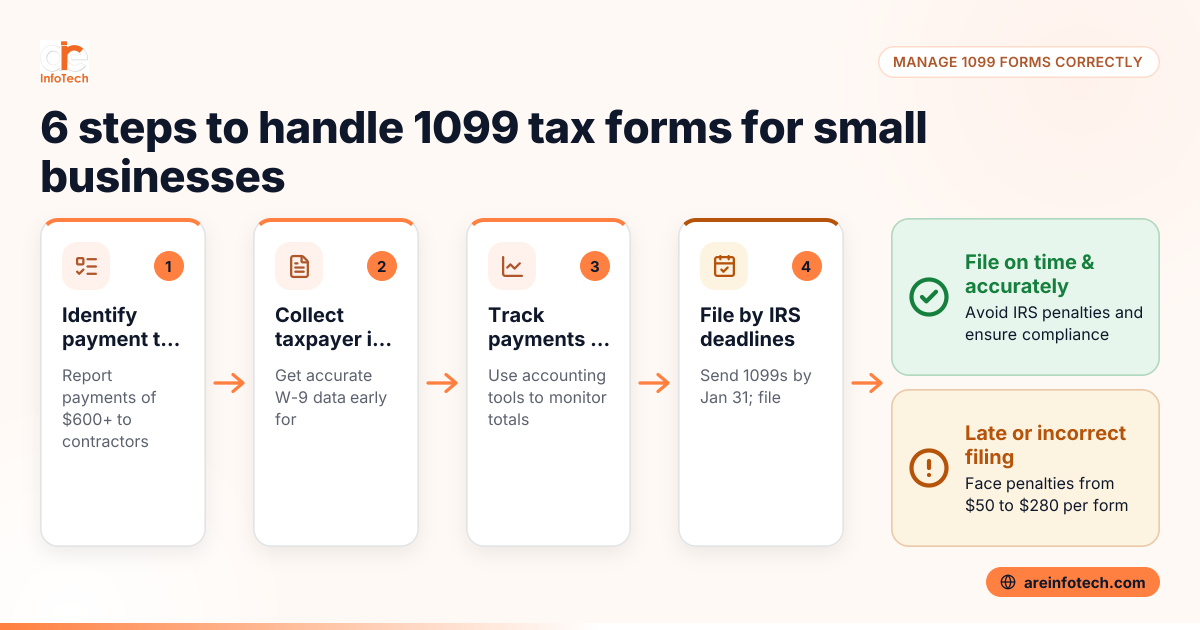
Managing 1099 tax forms is critical for small businesses in the United States to comply with IRS rules and avoid penalties. These forms report payments to independent contractors and other non-employees. Accurate and timely management ensures smooth tax filing and good vendor relationships.
1099 forms are a set of IRS documents used to report various types of income other than wages, typically paid to independent contractors, freelancers, landlords, and vendors. The most common for small businesses is Form 1099-NEC, which reports non-employee compensation.
Small businesses must manage 1099 forms to:
For example, a marketing consultant in Chicago paid $1,200 must receive a 1099-NEC from the hiring business by January 31. This process ensures transparency and correct taxation for both parties.
AI managing 1099 involves automating data collection, validation, and filing using advanced software tools integrated with payment and accounting systems.
AI solutions reduce human error by automatically verifying taxpayer identification numbers (TINs), flagging inconsistencies, and reminding businesses of deadlines. This automation streamlines the entire 1099 workflow, reduces compliance risk, and saves staff time—especially valuable in small businesses juggling multiple tasks.
Only payments totaling at least $600 in a calendar year to a non-employee require a 1099-NEC. This includes:
Payments to corporations generally don’t require 1099s, except for attorneys and a few exceptions.
When engaging a contractor, ask them to complete Form W-9. This form provides:
Storing W-9 information digitally, possibly integrated with your accounting software like QuickBooks, makes retrieving data for 1099 preparation efficient.
Use your finance stack (e.g., QuickBooks coupled with payment processors like Stripe) to monitor total amounts paid to each vendor. Organize payments by vendor and calendar year to identify who requires a 1099 form. An ERP system integration is especially helpful for manufacturing businesses in Detroit or Houston managing multiple vendor transactions.
Electronic filing is preferred for businesses issuing 250 or more forms but optional for smaller issuers.
Several software options exist for generating 1099s, including QuickBooks, Tax1099, and other specialized tools offering IRS e-filing. Choosing tools with AI managing 1099 capabilities can alert you to errors and automate reminders to contractors, reducing manual effort.
If you discover errors after filing, submit corrected 1099s promptly. This maintains compliance and reduces audit risk.
The IRS imposes penalties for failing to file 1099s on time or with incorrect information:
Maximum penalties depend on the business size and filing delay. Avoiding fines requires careful attention to deadlines and accuracy.
Technology integration is key for busy small businesses. Here's how:
These tools help businesses in cities like Houston or Chicago streamline tax compliance while focusing on operations.
Yes. IRS rules allow authorized electronic delivery of 1099 forms if contractors consent. Sending forms via secure email or through online portals is common practice. Make sure to obtain explicit consent and verify recipient email addresses to ensure compliance with TCPA and CAN-SPAM regulations.
If you want to explore digital workflows for 1099 tax forms further, ARE InfoTech’s the ARE InfoTech blog covers related automation strategies tailored for U.S. businesses.
An independent contractor is a self-employed person or business hired to perform specific tasks but not treated as an employee. Payments of $600 or more annually require issuing Form 1099-NEC. The IRS uses factors like control over work and payment methods to determine contractor status.
You need the contractor’s legal name, address, and TIN, usually collected via Form W-9. Also, track the total amount you paid them during the tax year. Accuracy in this data ensures proper reporting and compliance.
Report all payments made during the calendar year regardless of states. Keep state-specific tax rules in mind, as some states require separate 1099 filings. Consult with a tax professional or accountant familiar with multi-state compliance.
As of 2020, the 1099-NEC form is used specifically for reporting non-employee compensation, replacing box 7 on the 1099-MISC. The 1099-MISC continues to report other types of income such as rent, royalties, and prizes.
Yes. Electronic filing is encouraged and sometimes required. It speeds up processing, minimizes errors, and is straightforward with IRS-certified platforms. Businesses with more than 250 forms must file electronically.
Yes. The responsibility lies with the payer to file and issue 1099 forms when payments meet the $600 threshold, regardless of invoices. Proper documentation supports compliance and audit readiness.
By following these proven practices for managing 1099 tax forms, small businesses across the United States can ensure seamless tax reporting. Leveraging AI managing 1099 tools and integrating accounting systems will simplify compliance and free up valuable time to grow your business. For detailed digital marketing and compliance strategies tailored to U.S. manufacturers and service providers, browse the ARE InfoTech blog.
Google Reviews


