.
image
  • Home
  • Blog
  • How to Prepare Your Small Business for Voice Search Optimization in United States
image

How to Prepare Your Small Business for Voice Search Optimization in United States

image

ARE InfoTech

Voice search optimization for small businesses in the United States means tailoring your online presence to meet voice-activated queries on devices like smartphones and smart speakers. This helps your business connect with customers using natural, conversational language — especially for local searches — making it easier to capture quick, intent-driven leads.

Key takeaways

  • Voice search uses natural language, so content should be conversational and include question phrases.
  • Mobile-friendliness and fast website speed impact voice search rankings.
  • Local SEO is vital since many voice searches are location-based, tied to "near me" queries.
  • Structured data (schema markup) helps search engines better understand your business.
  • Claim and optimize your Google Business Profile for voice search visibility.
  • AI voice search technologies are evolving; preparing now keeps your small business competitive.

Why is voice search optimization important for small businesses in the United States?

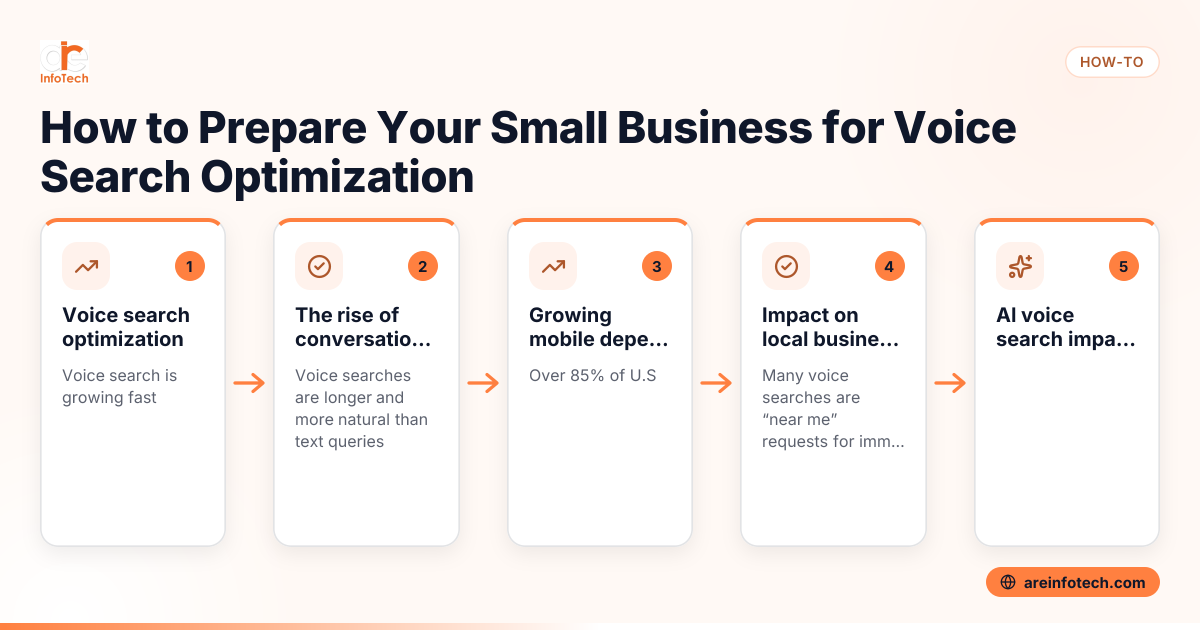
Voice search is growing fast, with millions of Americans using Alexa, Siri, or Google Assistant daily. Small businesses in places like Chicago or Houston gain more visibility by capturing voice-driven local queries, driving phone calls, foot traffic, and quick interactions without relying on typed searches.

The rise of conversational queries

Voice searches are longer and more natural than text queries. For example, instead of typing “pizza Chicago,” a customer might say, “Where’s the best gluten-free pizza near me?” Creating content with these human-like questions helps your business show up in voice results.

Growing mobile dependency

Over 85% of U.S. adults own smartphones, many performing voice searches on the go. A fast, mobile-optimized website ensures voice users get timely answers, crucial for local businesses competing in cities like Detroit.

Impact on local businesses

Many voice searches are “near me” requests for immediate needs, like a plumber or restaurant. Optimizing your digital presence for voice search connects you with customers ready to act — boosting leads and sales for your small business.

How does AI voice search impact your business strategy?

AI voice search technology improves assistants’ understanding of language and intent, making it essential for businesses to focus on conversational content that answers real customer questions clearly.

AI voice search influences your content by shifting the focus from exact keywords to user intent and context, encouraging businesses to develop FAQ pages and helpful guides that address common problems and interests.

Leveraging AI-driven tools

Tools powered by AI can analyze trending voice queries to optimize your SEO strategy. Staying updated on AI voice search trends helps your business maintain strong visibility as virtual assistants evolve.

Preparing for future competition

Adopting AI voice search strategies early ensures your small business stays competitive, connecting with consumers who increasingly rely on voice.

How to start with voice search optimization for your small business?

Starting with voice search optimization is straightforward and aligns with good SEO and mobile best practices.

Step 1: Audit your website and online presence

  • Test mobile-friendliness with Google’s Mobile-Friendly Test.
  • Check site speed with Google PageSpeed Insights; aim for under 3 seconds on mobile.
  • Review content to ensure it uses natural, conversational language.

Step 2: Research voice search queries and keywords

  • Use tools like AnswerThePublic and Google’s “People also ask” for question-based phrases.
  • Focus on terms like “how,” “where,” “near me,” and location-specific queries.

Step 3: Optimize Google Business Profile

  • Claim and verify your profile.
  • Keep NAP (Name, Address, Phone) information consistent.
  • Update business hours, photos, and respond to reviews.

Step 4: Build local citations and backlinks

  • List your business on directories like Yelp and Bing Places.
  • Confirm consistent information across listings.
  • Encourage customers to leave positive reviews.

Step 5: Implement structured data (Schema markup)

  • Add schema tagging for address, hours, services, and reviews.
  • Use Google’s Structured Data Markup Helper to assist implementation.

What role does local SEO play in voice search optimization?

Local SEO is critical since most voice searches are location-based. Businesses focusing on cities like Detroit or Houston should emphasize local relevance to show up in voice queries.

Embedding location signals

  • Use city and neighborhood names in titles, headings, and metadata.
  • Create specific location pages if serving multiple areas.
  • Embed Google Maps on contact pages.

Enhancing user engagement

  • Use Google Business Profile posts for promotions.
  • Leverage Q&A sections to answer popular questions.
  • Monitor and respond to reviews to build trust.

Example: A Detroit plumber’s local SEO strategy

Including phrases like “emergency leak repair near me Detroit” and using schema and updated Google profiles helps appear when locals use voice commands to find urgent services.

Which website and content optimizations help voice search results?

Optimizing content and site design improves voice search performance by supporting conversational queries.

1. Use natural, conversational keywords

  • Employ question-based phrases.
  • Example: Instead of “coffee shop Detroit,” use “Where can I find a coffee shop open late in Detroit?”

2. Add FAQ sections

  • Develop FAQs addressing common customer voice queries.
  • Provides quick answers favored by AI voice search engines.

3. Optimize for mobile

  • Ensure responsive website design.
  • Compress images and leverage caching for fast load times.

4. Enable HTTPS and security features

  • Secure sites gain favor from voice assistants.
  • SSL certificates boost trust and SEO.

5. Use structured data schema

  • Tag business details for clear voice assistant interpretation.

What is the best way to integrate voice search with your existing digital marketing?

Integrate voice search into your broader strategy to maximize results.

Update your keyword strategy

  • Add voice-friendly conversational phrases to SEO and PPC campaigns.

Promote voice-activated offers

  • Encourage customers to use voice commands for discounts or convenience.

Analyze voice lead conversion

  • Track leads from voice search to optimize follow-up and communication.

Train staff and automation

  • Prepare your team and tools to manage increased voice-generated interactions.

For tailored digital marketing solutions in the U.S., small businesses can explore the ARE InfoTech blog for expert insights on local SEO and AI voice search.

Frequently asked questions

What devices do consumers use for voice search most often?

Smartphones, smart speakers like Amazon Echo and Google Nest, and virtual assistants in cars are common voice search devices in the U.S., serving both mobile and home users.

How quickly should a website load for good voice search rankings?

Aim for loading times under 3 seconds on mobile for better user experience and voice search ranking.

Can small businesses without a website benefit from voice search?

Yes, optimizing your Google Business Profile can increase visibility, though a website improves credibility and ranks better for complex queries.

How do I track voice search performance?

Google Search Console reveals voice-related queries driving traffic. Combine with analytics to analyze patterns and improve content.

Is voice search optimization expensive for small businesses?

Many tactics overlap with conventional SEO, making voice search optimization cost-effective within existing marketing budgets.

Will voice search replace typed search soon?

Voice search grows rapidly but won’t replace typing completely. Most U.S. users use both based on context.


Optimizing voice search for your small business enhances local visibility and connects with customers who use AI voice search daily. With local SEO, mobile optimization, structured data, and conversational content, your business gains a competitive edge. Visit the ARE InfoTech blog for more U.S.-focused digital marketing strategies.

Google Reviews

image

image