
Creating a GDPR-compliant data privacy strategy is essential for US businesses handling the personal data of European Union (EU) citizens. Although GDPR is an EU regulation, US companies must comply to avoid steep fines and reputational damage. This article outlines key steps to align your data practices with GDPR requirements in 2024.
GDPR compliance for US businesses means following the EU General Data Protection Regulation when processing data from EU residents. It requires transparency, security, and respecting privacy rights regardless of company location. Non-compliance risks include fines up to €20 million or 4% of global turnover.
US companies often overlook GDPR, but it applies if you offer goods, services, or track behavior of EU residents. Enforcement is increasing, so prioritizing compliance protects your legal standing and customer trust.
US businesses processing EU citizens’ personal data must comply with GDPR. This affects Chicago e-commerce, Houston SaaS, or Detroit manufacturers with EU clients. GDPR requires lawful use, transparency, and fulfilling data subject rights like access or deletion.
GDPR impacts cross-border data flows by mandating strict rules on data transfer and usage to protect EU residents.
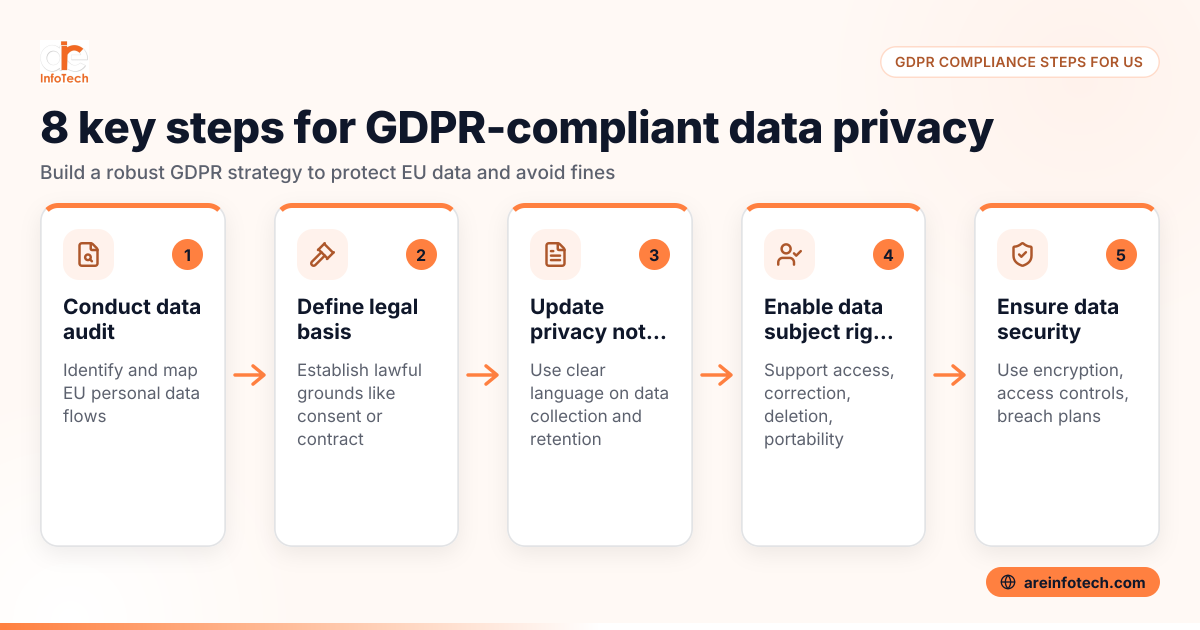
The following eight steps form a comprehensive GDPR framework for US businesses.
Identify all EU personal data your business processes. Document data types, collection points, storage, and access. Mapping helps focus compliance efforts.
Establish lawful grounds such as consent, contract necessity, or legitimate interest. Consent must be explicit for sensitive data.
Update your privacy policy with clear language. Explain what data you collect, why, retention periods, rights, and contacts. Transparency builds trust.
Enable EU individuals to exercise rights: access, correction, deletion, restriction, and portability. Respond promptly within GDPR timelines.
Apply technical and organizational measures like encryption, access controls, and breach response plans to protect personal data.
Transfers of EU data to the US require safeguards such as Standard Contractual Clauses (SCCs) or Binding Corporate Rules (BCRs). Post-Schrems II, these are mandatory.
Educate staff on GDPR principles, breach reporting, and sensitive data handling. Well-trained employees reduce compliance risks.
Maintain processing records and monitor ongoing compliance. Proactively update practices based on risks and regulations.
AI GDPR compliance means ensuring AI tools help with tasks like data mapping and consent management without violating GDPR rules. Automated decisions need human oversight, and personal data processed by AI must remain secure.
AI can streamline GDPR compliance but requires careful configuration to avoid privacy breaches or unlawful profiling.
Consent must be freely given, specific, informed, and unambiguous. Pre-ticked boxes or blanket approvals don’t count. US businesses should implement clear consent mechanisms and allow easy withdrawal.
Notify EU authorities within 72 hours when a breach risks individuals. If serious, inform affected persons quickly. Set up incident response teams to meet these deadlines.
Use double opt-in email subscriptions, clear opt-out options, and avoid intrusive profiling without consent. Align GDPR with CAN-SPAM and TCPA regulations to enhance outreach.
Documentation proves accountability—a core GDPR principle—during audits or investigations. Log consent, processing activities, and privacy impact assessments. For example, recording consent with QuickBooks or Stripe transactions involving EU customers strengthens compliance evidence.
SMEs can start with basic audits and privacy updates. Use CRM or ERP systems to streamline compliance. Businesses in Chicago or Houston might find consulting experts like ARE InfoTech helpful for tailored strategies.
Compliance is ongoing. Conduct regular audits, update policies, and adapt to regulatory changes. US businesses dealing with multinational clients need to stay current with evolving data protections.
This article naturally includes the keyword "GDPR compliance for US businesses" in headings and text. Terms like "data privacy strategy," "data subject rights," "data breach notification," "international data transfers," and "AI GDPR compliance" appear clearly. US business examples make content relevant and practical. Internal links to the ARE InfoTech blog improve engagement and authority. The balance between SEO and readability serves both users and search engines well.
GDPR protects any information related to an identified or identifiable EU resident, including names, emails, IP addresses, financial data, health info, and behavioral tracking data.
Yes. GDPR covers US businesses offering goods or services to EU residents or monitoring their behavior, regardless of physical location.
AI tools can help automate compliance tasks but must respect privacy rights and avoid automated decisions without human review.
Fines can reach €20 million or 4% of global revenue. Beyond penalties, violations damage reputation and customer trust.
Update policies at least annually or when your business or regulations change, keeping compliance current.
For US businesses aiming to build a robust GDPR-compliant data privacy strategy in 2024, following these practices and seeking expert guidance from agencies like ARE InfoTech ensures legal security and sustained customer trust. Discover more digital marketing insights tailored to US businesses on the ARE InfoTech blog.
Google Reviews


